
free-placement mechanic asserted
Building placement
The player places discrete structures on a grid or freely, and placement constraints turn layout into a spatial puzzle.
watch
4 shorts with this record on screen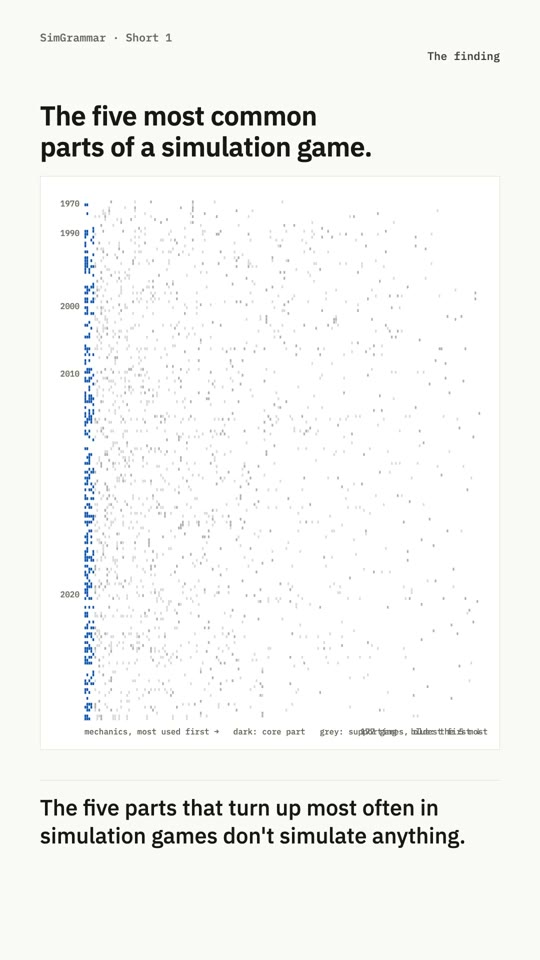 play · 0:38
short 1 0:38
The five most common parts
transcript
The five parts that turn up most often in simulation games don't simulate anything.
We broke 179 of them into their parts. First is the pause button, in 46 percent of them. Then placing buildings where you like, support for mods, a tech tree, and scenario goals.
Production chains come sixth, and they're the first part on the list that models something in the world: ore into plates, plates into gears.
The parts a game is known for are rare. RimWorld's storyteller, its mood breaks and its body-part injuries each show up in fewer than ten catalog games.
also on the pages for
 Modding API
 Scenario objectives
 Tech tree
 Pause and speed control
 Injury body model
 Mood and breakdowns
 Storyteller director
 Production chains
 play · 0:36
short 3 0:36
A border post and a daughter
transcript
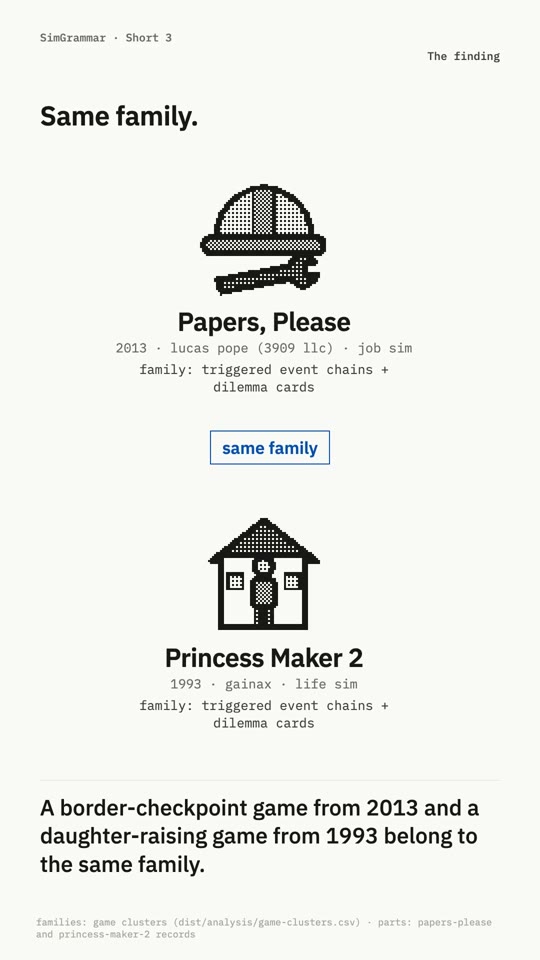
A border-checkpoint game from 2013 and a daughter-raising game from 1993 belong to the same family.
We grouped 179 simulation games by the parts they're built from, then redid the grouping on 1000 random subsets of the catalog. These two land together almost every time.
Both give you time in fixed slots: a shift at the border, three slots a month for your daughter. Both keep money tight. Both keep sending authored events at you.
Princess Maker 2 is filed as a life sim, and it lands far from The Sims.
also on the pages for
 Agent skills
 Treasury and budget
 Care-dependent development
 Daily action budget
 Lifecycle and aging
 Needs decay
 Rule-checking inspection
 Triggered event chains
 Career ladder
 play · 0:38
short 8 0:38
City builders don't tell stories
transcript
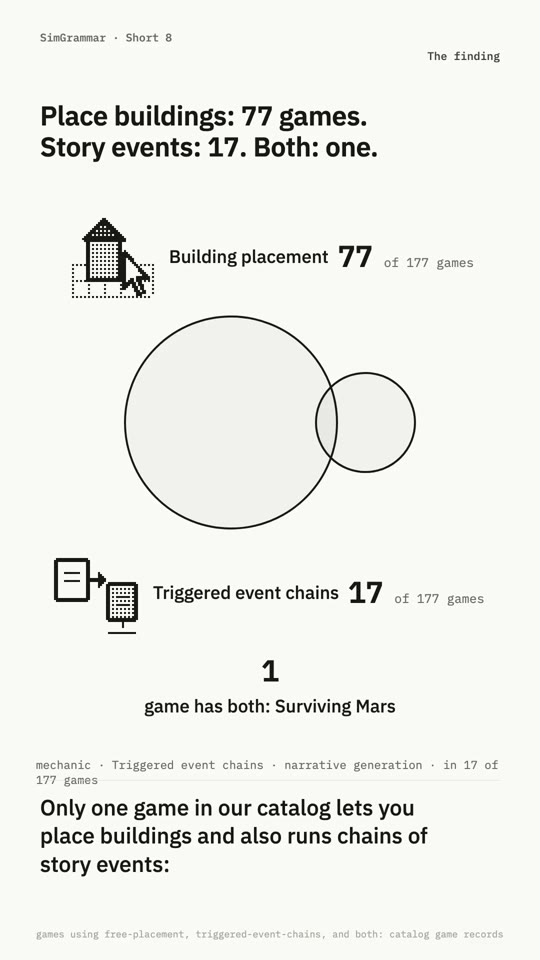
Only one game in our catalog lets you place buildings and also runs chains of story events: 77 games do the first, 17 the second.
In Cities: Skylines, a district built all at once grows old all at once. Decades later its residents die in a wave, and the hearses back up. The game treats it as a services problem. Nothing tells you a story about any of them.
The exception is Surviving Mars, which lays authored mysteries like plagues and AI revolts over a colony you lay out yourself. Even there, the mysteries are layered on top of the colony.
also on the pages for
 Power grid
 play · 0:33
short 12 0:33
The parts the agents skipped
transcript
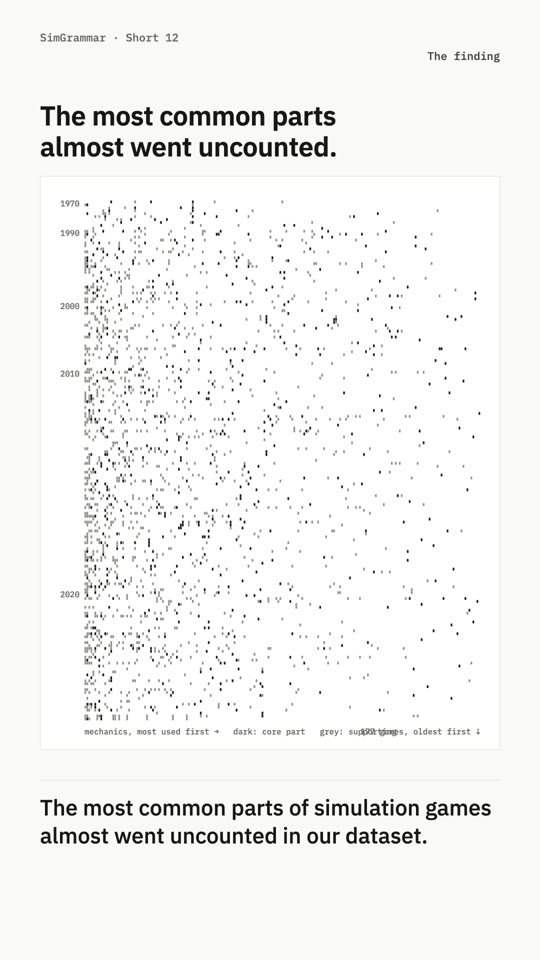
The most common parts of simulation games almost went uncounted in our dataset.
The first catalog was built by AI agents working in parallel. Each one recorded the parts that made a game distinctive and skipped the obvious ones: the pause button, placing buildings, tech trees. An outside review caught it.
Once the gaps were filled, the pause button turned out to be the most common part of all, in 46 percent of the catalog. Now every number in this series is checked against the data each time it's built.
also on the pages for
definition
The player picks a structure type, position, and usually rotation. The game tests the footprint against occupancy, terrain slope, required neighbors (road access, a water tile, an ore patch), and cost. A valid placement writes the structure into the occupancy grid or spatial index and deducts cost; demolition reverses it, often with a partial refund. Tile grids (SimCity, Factorio, RimWorld) make footprints exact; gridless placement (Manor Lords, Foundation) allows arbitrary angles and curved streets. A ghost preview tinted valid or invalid is the standard interface. The occupancy map is the input to pathing, coverage, adjacency, and room detection.
player experience
A spatial puzzle with immediate feedback. Players plan space, fit footprints together, and live with early decisions as the layout fills. Gridless placement adds expressive freedom but also the chore of aligning things by eye.
design levers
- grid, offset grid, or gridless placement, with or without snapping
- footprint sizes and shapes, and whether rotation changes them
- terrain rules: slope tolerance, water, and foundations
- requirement rules such as road adjacency or resource tiles
- demolition refund and rebuild cost, which set how much commitment a placement carries
failure modes
- Gridless placement leaves slivers and gaps that waste space and look untidy.
- Free demolition and full refunds remove commitment, so placement stops being a decision.
- A red ghost with no reason given makes hidden placement rules feel arbitrary.
- Permissive rules with abundant space make layout trivial.
dynamics
- Early placements constrain later ones, producing path-dependent layouts and eventual rebuilds.
- Space becomes a resource that players trade against throughput or beauty.
- Players converge on standard modules, which leads to blueprint copying and sharing.
open questions
- Can natural-language or sketch placement ("put a market near the docks") keep the puzzle while removing the click cost?
- Which footprint rules make gridless placement as plannable as a grid?
appears in
the paper, 2 sections · 5 chapters · 5 episodes · 4 shortsFamilies across genres
on screen at 0:17 cold open, 0:27 same chain, different games, 3:38 odd couples, 5:12 series and descendants and 2 more
 Adjacency scoring
 Room recognition