
career-ladder mechanic sourced
Career ladder
Characters advance through ranked job levels by meeting skill, relationship, and performance requirements.
watch
1 short with this record on screen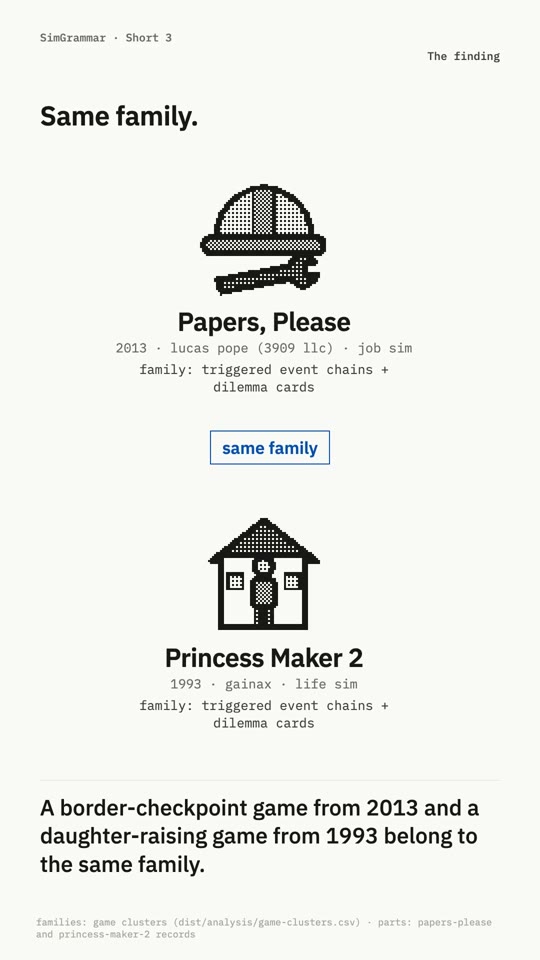 play · 0:36
short 3 0:36
A border post and a daughter
transcript
A border-checkpoint game from 2013 and a daughter-raising game from 1993 belong to the same family.
We grouped 179 simulation games by the parts they're built from, then redid the grouping on 1000 random subsets of the catalog. These two land together almost every time.
Both give you time in fixed slots: a shift at the border, three slots a month for your daughter. Both keep money tight. Both keep sending authored events at you.
Princess Maker 2 is filed as a life sim, and it lands far from The Sims.
also on the pages for
 Agent skills
 Treasury and budget
 Care-dependent development
 Daily action budget
 Lifecycle and aging
 Needs decay
 Rule-checking inspection
 Triggered event chains
 Building placement
definition
A career is an ordered list of levels, each with a title, pay, schedule, and promotion requirements. State owned: per character, current career and level, and a job performance meter. Update rule: each work period, performance changes based on attendance and inputs such as mood, skills, or task completion; when performance and the next level's requirements are met, the character is promoted; very low performance or missed shifts cause demotion or firing. Inputs come from other mechanics (skills, relationships, needs); outputs are income, schedule, and status. Canonical form: The Sims 2, where adult careers have ten levels, teen careers three, promotion requires advances in three skills, a number of household friends, and high mood, and missing work two days in a row gets a Sim fired; The Sims 4 adds daily career tasks and branching tracks.
player experience
A long-term arc for one character. The player schedules skill-building and socializing around work, watches the performance bar before a promotion, and feels the status jump of a new title and pay. It gives sandbox life a direction.
design levers
- number of levels and spacing of requirements
- requirement types: skills, relationships, mood, or task completion
- performance meter rate and decay
- branching tracks at upper levels
- random work events with choices, such as The Sims chance cards
- pay and schedule curve across levels
failure modes
- Requirements become a checklist that drains spontaneity from life simulation.
- Rabbit-hole careers where the Sim leaves the lot make the career invisible to play.
- Pay grows faster than costs, so money stops mattering by mid-career.
dynamics
- Career requirements route characters' free time into skill and friend grinding, coupling work to social and needs systems.
- Schedule conflicts between household members' careers create household logistics problems.
- Promotions raise income and enable home upgrades, a reinforcing loop toward comfort.
open questions
- Can generated workplaces with colleagues, tasks, and politics replace authored rabbit-hole careers without large writing costs?
- Does requirement opacity, like a real workplace, make careers more engaging than explicit checklists?
appears in
the paper, 2 sections · 1 episode · 1 shortbacklinks
computed from other records Agent-based automated playtesting and balancing
claims
1 with sourcesIn The Sims 2 adult careers have ten levels and teen careers three; promotion requires advancing three skills, enough household friends, and high mood, and missing work two days in a row causes firing.