rimworld game sourced
RimWorld
A colony sim where a few named colonists with needs, traits, injuries, and relationships survive on a frontier planet while a storyteller AI paces events.
parts
25 mechanics, as RimWorld does themcore · 7

Adaptive threat scaling
Raid strength scales with colony wealth, number of colonists, and difficulty, so growth raises danger.
Injury body model
Bodies are hierarchies of parts with hit points, bleeding, infection, scars, and prosthetics that change capacities like moving and manipulation.

Memories and thoughts
Every mood effect is an itemized thought with a source and expiry, visible in the needs tab.

Mood and breakdowns
Mood below trait-adjusted break thresholds triggers minor, major, or extreme mental breaks; high mood can grant inspirations.

Needs decay
Colonists track food, rest, recreation, comfort, beauty, and other needs whose levels feed mood.
Storyteller director
Selectable storytellers (Cassandra, Phoebe, Randy) choose incidents using a threat budget derived from colony wealth and time since the last major event.
Work priorities
A work tab matrix sets 1-4 priorities per colonist per job type; colonists self-assign.
supporting · 18

Agent inspection
Agent skills
Autonomy levels
Drafting switches a colonist from self-assigned work to direct player control for combat or emergencies.
Crop cultivation
Decoration and beauty
Designation orders

Fire spread

Modding API
XML definitions and C# assemblies, usually patched in with Harmony, distributed through Steam Workshop.

Pause and speed control

Permadeath
Personality traits
Procedural characters
Raid defense
Relationship values

Room recognition
Spoilage
Storage and buffers
Utility action selection
watch
2 shorts with this record on screen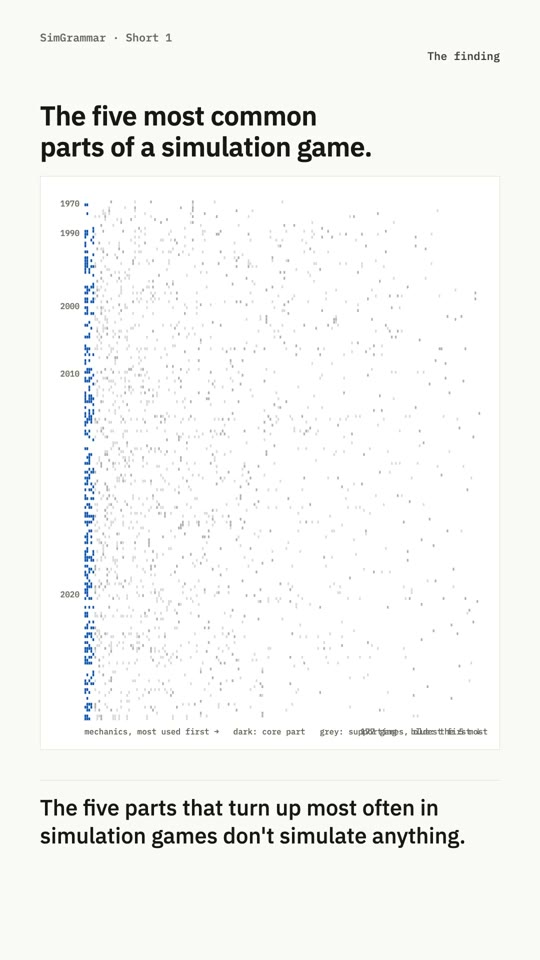 play · 0:38
short 1 0:38
The five most common parts
transcript
The five parts that turn up most often in simulation games don't simulate anything.
We broke 179 of them into their parts. First is the pause button, in 46 percent of them. Then placing buildings where you like, support for mods, a tech tree, and scenario goals.
Production chains come sixth, and they're the first part on the list that models something in the world: ore into plates, plates into gears.
The parts a game is known for are rare. RimWorld's storyteller, its mood breaks and its body-part injuries each show up in fewer than ten catalog games.
also on the pages for
 Building placement
 Scenario objectives
 Tech tree
 Production chains
 play · 0:36
short 4 0:36
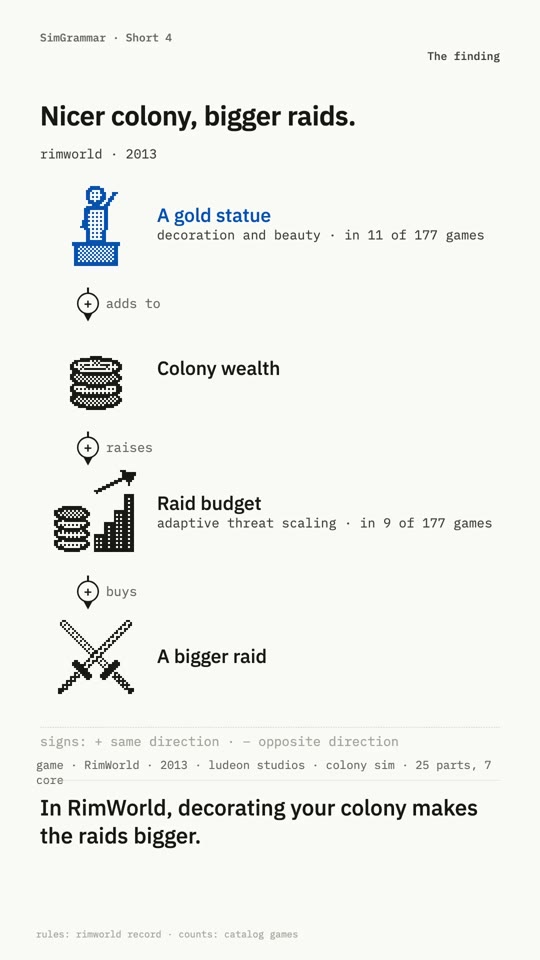
Decorating makes the raids bigger
transcript
In RimWorld, decorating your colony makes the raids bigger.
Before every raid the game adds up your colony's wealth and your colonists and turns the total into a budget for the attackers. Wealth starts adding to that budget above 14,000 and keeps adding up to a million [1].
So experienced players keep their colonies plain. They skip the statues and the fine furniture so the raids stay small.
None of it is on screen. The formula lives on the community wiki, and the dataset scores the mechanic 2 out of 5 for legibility, the level where players understand it only through wikis.
also on the pages for
core loop
designate work -> colonists self-assign by priority -> needs and moods shift -> storyteller injects events -> colony adapts or collapses
design notes
Tynan Sylvester describes RimWorld as a story generator. Its systems are chosen for how legible and story-relevant their outputs are rather than for realism: thoughts are itemized with sources and durations, injuries are named body parts, and raids scale with colony wealth to keep tension.
appears in
the paper, 4 sections · 10 chapters · 7 episodes · 2 shortsEvery simulation game is made of the same parts
on screen at 0:00 cold open, 0:32 rimworld, in parts, 3:01 where identity lives
The five ceilings
on screen at 2:39 ticks per second, 3:47 what a player can follow, 4:59 minds made of formulas