princess-maker-2 game sourced
Princess Maker 2
A raising sim in which the player, as a father figure, schedules a daughter's training, part-time jobs, rest, and adventures from age 10 to 18, and her accumulated attributes decide one of 74 endings.
parts
9 mechanics, as Princess Maker 2 does themcore · 4

Agent skills
Training courses and part-time jobs raise and lower her attributes; attributes gate jobs, decide October festival contests in martial arts, dance, art, and cooking against rival girls, and select the final career.

Care-dependent development
Eight years of scheduled training, jobs, and rest shape the daughter's attributes, and at 18 her attributes and history select one of 74 career endings.

Daily action budget
Each month has three activity slots (early, middle, late), so every period spent training, working, adventuring, or resting is a period not spent on the others.

Lifecycle and aging
The daughter ages from 10 to 18; jobs and events unlock with age, and the game ends at 18.
supporting · 5

Career ladder
Repeating a part-time job leads to promotions, higher pay, and bonuses for unbroken success streaks.

Needs decay
Stress from work and training is relieved by free time, vacations, spa stays, or bed rest; poor rest management leads to illness and weaker performance.

Treasury and budget
A small annual income pays for lessons, clothing, food, treatment, and shopping; jobs supplement it.

Triggered event chains
Events and reactions fire on age, attributes, and season, leading into 74 career endings with retrospective sequences.

Turn structure
The month is the turn, split into three phases that resolve after the player sets the schedule.
watch
2 shorts with this record on screen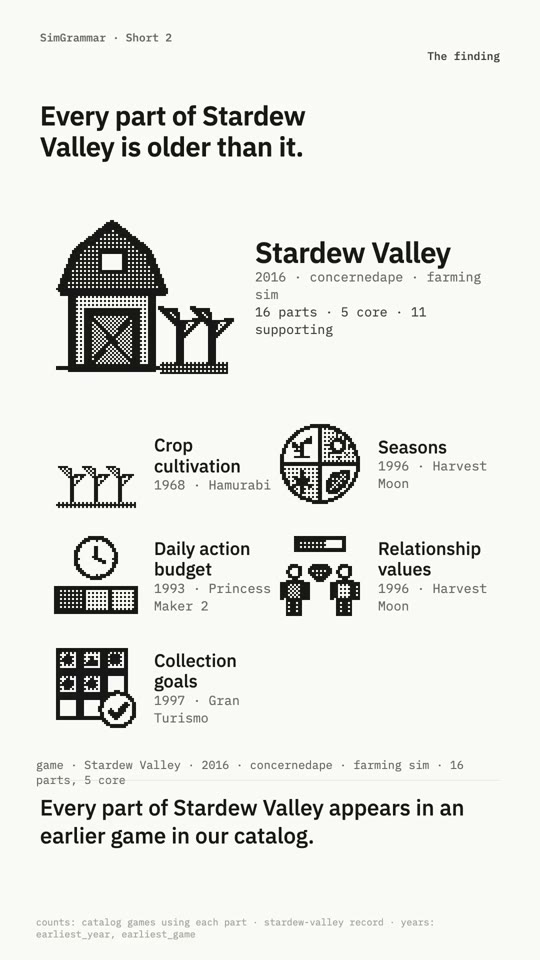 play · 0:40
short 2 0:40
Every part of Stardew Valley is older than it
transcript
Every part of Stardew Valley appears in an earlier game in our catalog.
Crops first appear in Hamurabi, a text game from 1968. A daily action budget first appears in Princess Maker 2, in 1993. Seasons and friendships with villagers first appear in Harvest Moon, in 1996, the game Stardew was built in response to.
That is the norm. Games released since 2010 draw 84 percent of their mechanics from parts that already existed by 2000.
Stardew sets its own numbers: 250 friendship points a heart, and two lost on each day you don't talk to someone.
also on the pages for
 Relationship values
 Crop cultivation
 Seasons
 Collection goals
 Seasonal world reset
 play · 0:36
short 3 0:36
A border post and a daughter
transcript
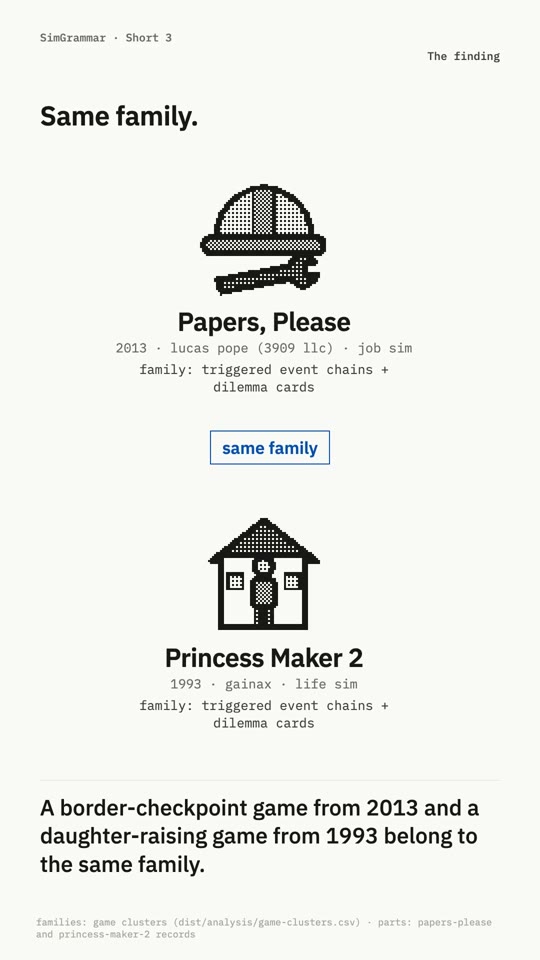
A border-checkpoint game from 2013 and a daughter-raising game from 1993 belong to the same family.
We grouped 179 simulation games by the parts they're built from, then redid the grouping on 1000 random subsets of the catalog. These two land together almost every time.
Both give you time in fixed slots: a shift at the border, three slots a month for your daughter. Both keep money tight. Both keep sending authored events at you.
Princess Maker 2 is filed as a life sim, and it lands far from The Sims.
also on the pages for
 Rule-checking inspection
 Building placement
core loop
set three activity periods for the month -> training and jobs change attributes, money, and fatigue -> events and festivals test her attributes -> rest or vacation to prevent illness -> she ages a year -> at 18 her attributes select a career ending
design notes
Takami Akai designed the sequel to answer complaints that the original was repetitive, adding more reactions and events around a schedule-and-attributes core. Each month splits into early, middle, and late periods, each assigned to training (academic, artistic, religious, military, or magical), a part-time job, adventure, or free time, under a small annual income. Jobs unlock with age and pay promotion and streak bonuses, rival girls age alongside the daughter as benchmarks, and October festivals hold contests in martial arts, dance, art, and cooking. At 18 her attributes and history select one of 74 career endings, a branching-outcome model captured by the care-dependent-development mechanic.