
needs-decay mechanic asserted
Needs decay
Each agent has needs such as hunger, energy, social, and fun that decay over time and are restored by actions.
watch
2 shorts with this record on screen play · 0:36
short 3 0:36
A border post and a daughter
transcript
A border-checkpoint game from 2013 and a daughter-raising game from 1993 belong to the same family.
We grouped 179 simulation games by the parts they're built from, then redid the grouping on 1000 random subsets of the catalog. These two land together almost every time.
Both give you time in fixed slots: a shift at the border, three slots a month for your daughter. Both keep money tight. Both keep sending authored events at you.
Princess Maker 2 is filed as a life sim, and it lands far from The Sims.
also on the pages for
 Agent skills
 Treasury and budget
 Care-dependent development
 Daily action budget
 Lifecycle and aging
 Rule-checking inspection
 Triggered event chains
 Career ladder
 Building placement
 play · 0:36
short 5 0:36
The refrigerator knows
transcript
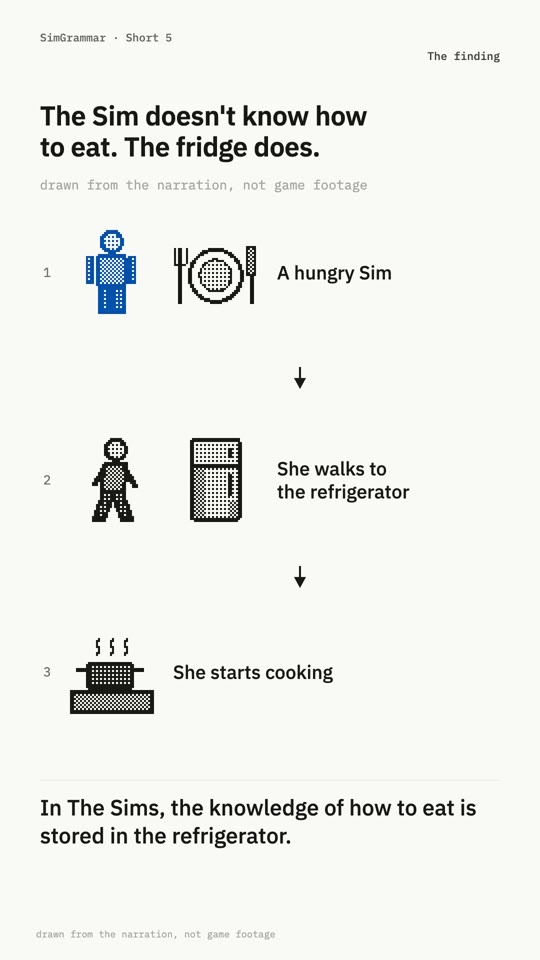
In The Sims, the knowledge of how to eat is stored in the refrigerator.
Every object advertises what it offers. The refrigerator advertises Hunger, the bed Energy. A Sim weighs the offers in reach against what it needs and picks one, and the object brings the script and the animation [1].
Expansions taught Sims new things largely by selling them new objects.
It also meant every behavior was made by hand. The base game shipped with more than 150 objects, and the dataset scores the method 4 out of 5 for authoring cost.
also on the pages for
definition
Each agent holds a vector of bounded need stocks (typically 0-100). Every tick each stock decays at a per-need rate, optionally modified by traits, activity, and environment. Actions or objects restore specific needs by fixed or quality-scaled amounts. Low values feed downstream systems: mood, action selection priority, health, or death.
player experience
Constant low-grade triage. The player reads meters, anticipates which need will bottom out first, and arranges the environment or schedule so agents can meet needs without supervision. Neglect is visible and personal.
design levers
- number of needs and which are lethal versus mood-only
- decay rate per need and modifiers by trait, age, or activity
- restoration amount and duration per action or object quality
- threshold values that trigger warnings, priority overrides, or breakdowns
- whether needs are shown as raw meters, icons, or only through behavior
failure modes
- Too many needs turn play into chore management with no strategic choice.
- Uniform decay rates make every agent identical and remove personality.
- Fast decay with slow restoration produces unavoidable death spirals early in a run.
- Hidden needs read as random misbehavior when agents act on them.
dynamics
- Synchronized decay creates rush hours at kitchens, beds, and bathrooms.
- Needs compete for agent time, so throughput falls as needs rise, coupling productivity to comfort.
- Better objects restore more per use, creating an upgrade treadmill.
open questions
- Can needs be inferred from behavior by learned agents rather than declared as fixed meters?
- What is the minimal need set that still yields distinct personalities?
appears in
the paper, 2 sections · 1 chapter · 6 episodes · 2 shortsrelations
1 stored edges Smart objects
Objects advertising need restoration turn decaying needs into autonomous, legible daily behavior (The Sims).
 Creature care
 Survival meters
 Daily schedules
 Mood and breakdowns