factorio game sourced
Factorio
A factory automation game in which the player builds belt, train, robot, and circuit networks that mine, refine, and assemble items on an alien planet while pollution provokes native biters that evolve over time.
parts
28 mechanics, as Factorio does themcore · 8
Adaptive threat scaling
An evolution factor rises with elapsed time, total pollution produced, and spawners destroyed, squashed as total over one plus total, and unlocks medium, big, and behemoth enemies.
Conveyor transport
Two-lane belts in four tiers carry 15, 30, 45, or 60 items per second; splitters, undergrounds, and lane priorities shape flow, and inserters move items between belts and machines.

Pollution spread
Machines emit pollution into 32x32 chunks; above 15 units a chunk diffuses 2% to each cardinal neighbor every 64 ticks, and water, grass, and trees absorb it.

Power grid
Steam engines, solar panels, accumulators, and nuclear reactors feed a pole-connected grid; under shortage power is shared evenly so all machines slow proportionally.

Production chains
Assembling machines, furnaces, chemical plants, and refineries run fixed recipes with crafting times; science packs require multi-step trees from ore to circuits, oil products, and rocket parts.
Raid defense
Biter and spitter nests send attack groups when their chunk absorbs pollution, recruiting units at pollution costs from 4 for a small biter to 400 for a behemoth; turrets, walls, and flamethrowers defend.

Resource extraction
Electric and burner mining drills extract iron, copper, coal, stone, and uranium from ore patches at rates set by drill tier and mining productivity research; pumpjacks extract crude oil.

Tech tree
Labs consume science packs of rising recipe complexity to research a technology graph that leads through oil processing, robots, and nuclear power to the rocket silo.
supporting · 20

Blueprints
Selected areas save to blueprints, books, and a personal library that persists across saves; exchange strings are shared online, and construction robots build pasted ghosts.
Building placement
Deposit depletion
Ore tiles run out as they are mined, and crude oil wells decline toward a 20% yield floor, pushing expansion to new patches.
Direct avatar control
The engineer walks the map, mines by hand early, and places buildings within reach, later driving cars, tanks, and spidertrons.

Fluid pipe networks
Pipes and pumps carry water, crude oil, petroleum, and steam; version 2.0 merged pipes into segments that share contents.

Hand crafting
The engineer crafts early buildings and items from inventory using the same recipes as assemblers, with a crafting queue.

Machine boosting
Speed, productivity, efficiency, and (Space Age) quality modules fill machine slots, and beacons project module effects onto neighboring machines at a power cost; productivity bonuses are capped at +300%.
Megaproject sink
The rocket silo consumes rocket parts for each launch, and launching a rocket ends the base game; Space Age moves the goal to a space platform reaching the edge of the solar system.
Modding API
Mods use a modified Lua 5.2 with data and control stages and are distributed through an in-game mod portal; overhauls such as Krastorio 2 replace progression.
Procedural terrain
Maps are generated from a seed with settings for ore frequency, size, and richness, water, cliffs, and enemy bases.

Quality tiers
The Space Age expansion adds five quality levels from normal to legendary, raised by chance from quality modules, with a recycler that returns 25% of ingredients.
Rail signaling
Rail and chain signals divide track into blocks that one train reserves at a time, letting train networks share track.
Request-provider logistics
Roboports define logistic zones where logistic robots carry items among active provider, passive provider, storage, buffer, and requester chests by priority, one item per trip at 3 tiles per second before research.

Signal circuits
Red and green wires carry item-count signals into arithmetic, decider, constant, and (in 2.0) selector combinators that control inserters, belts, train stops, and lamps.

Spoilage
In Space Age, Gleba's agricultural products spoil over fixed timers into spoilage, and recipe outputs inherit ingredient freshness.
Stats dashboards
Production and consumption graphs per item over time windows and an electric network panel show where ratios fail.
Storage and buffers
Chests, storage tanks, and the logistic network's storage chests buffer items, and full outputs stall machines upstream.
Track laying
Straight and curved rail pieces are placed to build train networks, with elevated rails in Space Age, and the rail planner lays segments between points.
Vehicle routes and schedules
Trains run schedules of stations with wait conditions on cargo, time, inactivity, or circuit signals.
Vertical layers
Space Age elevated rails let a second track layer cross over ground tracks and buildings.
watch
2 shorts with this record on screen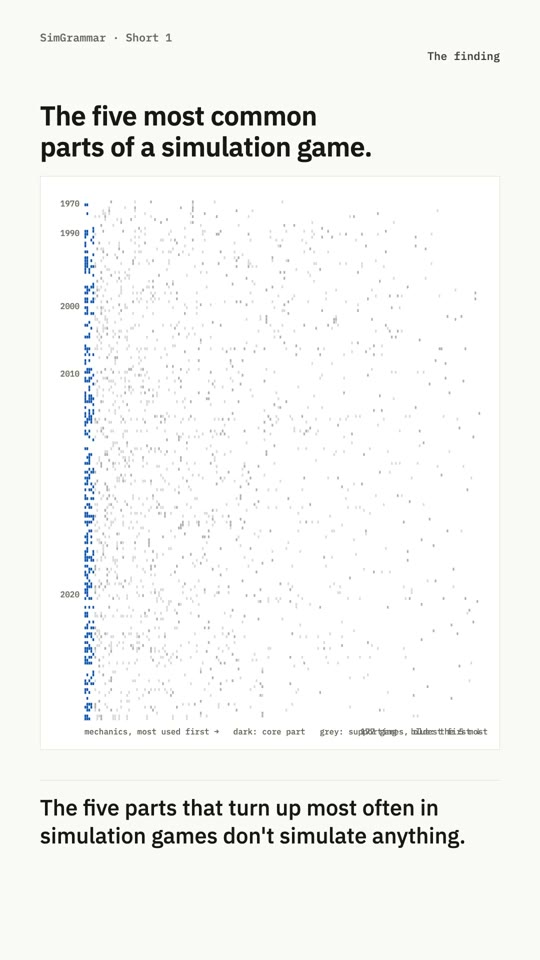 play · 0:38
short 1 0:38
The five most common parts
transcript
The five parts that turn up most often in simulation games don't simulate anything.
We broke 179 of them into their parts. First is the pause button, in 46 percent of them. Then placing buildings where you like, support for mods, a tech tree, and scenario goals.
Production chains come sixth, and they're the first part on the list that models something in the world: ore into plates, plates into gears.
The parts a game is known for are rare. RimWorld's storyteller, its mood breaks and its body-part injuries each show up in fewer than ten catalog games.
also on the pages for
 Scenario objectives
 Pause and speed control
 Injury body model
 Mood and breakdowns
 Storyteller director
 play · 0:36
short 7 0:36
Most used, barely touched
transcript
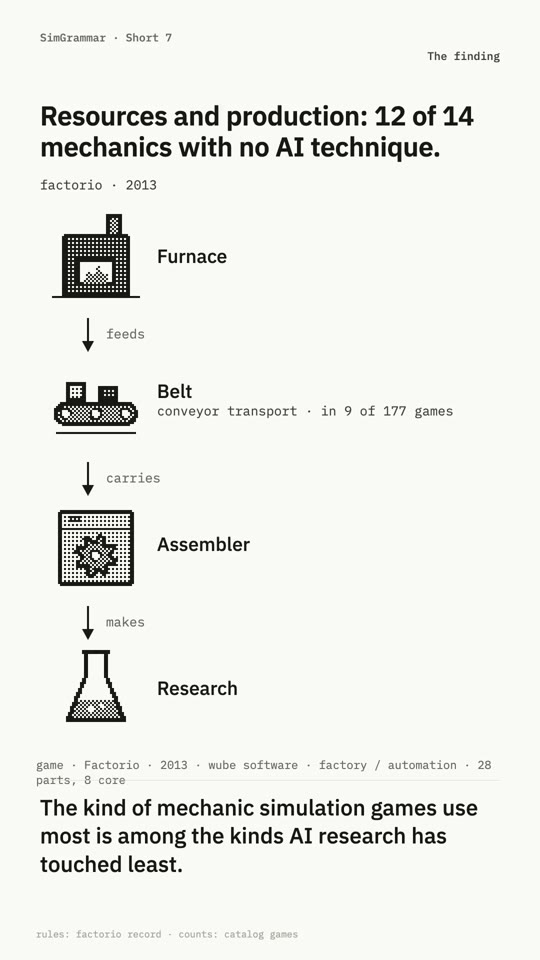
The kind of mechanic simulation games use most is among the kinds AI research has touched least.
Resources and production is the most used family in our catalog. Of its 14 mechanics, 12 have no AI technique pointed at them, production chains included.
A furnace starves far upstream, and the player blames the building in front of them. The record for production chains lists that as a known failure in games without flow statistics.
Instead the techniques pile up on stories and characters. Narrative and generation is the most exposed family in the set.
also on the pages for
core loop
mine ore -> smelt and assemble on belts and inserters -> feed science packs to labs -> research new machines -> pollution draws biter attacks -> defend and expand outposts by rail -> launch a rocket
design notes
Lead designer Michal Kovarik cited the Minecraft tech mods IndustrialCraft and BuildCraft; Factorio turned their pipes and machines into a standalone game where ratio planning and layout are the challenge. Item movement is discrete and deterministic (belts carry 15, 30, 45, or 60 items per second across two lanes), which makes throughput legible and lets the lockstep multiplayer simulate identical worlds. Pollution couples industry to combat: chunks above 15 units diffuse 2% to neighbors, spawners that absorb it send attack groups, and total pollution produced drives the enemy evolution factor. Each layer of logistics (belts, trains with block signals, roboport-based logistic and construction robots, circuit combinators) is a mechanic the player adopts when the previous one stops scaling, and blueprints let solved layouts be reused. Speed, productivity, and efficiency modules and beacons that trade power for throughput, and the rocket silo as a terminal sink for produced parts, have no taxonomy entry; this run proposed both.
appears in
the paper, 4 sections · 9 chapters · 8 episodes · 2 shortsWhere the parts came from
on screen at 1:13 a date is a lower bound, 5:18 after 2000, 7:21 built from older parts
Families across genres
on screen at 0:00 cold open, 0:27 same chain, different games, 5:12 series and descendants
relations
1 stored edgesbacklinks
computed from other recordsclaims
2 with sourcesFactorio was publicly purchasable as an alpha from its official site in 2013, after the February 2013 Indiegogo campaign, three years before Steam early access on 2016-02-25; `year` records the 2013 alpha.
The design grew out of the Minecraft tech mods IndustrialCraft and BuildCraft, which lead designer Michal Kovarik cited; the `influenced_by` edge to Minecraft records that mod lineage.