
agent-skills mechanic sourced
Agent skills
Agents gain skill through practice or training, and skill sets work speed, quality, and access to tasks.
watch
1 short with this record on screen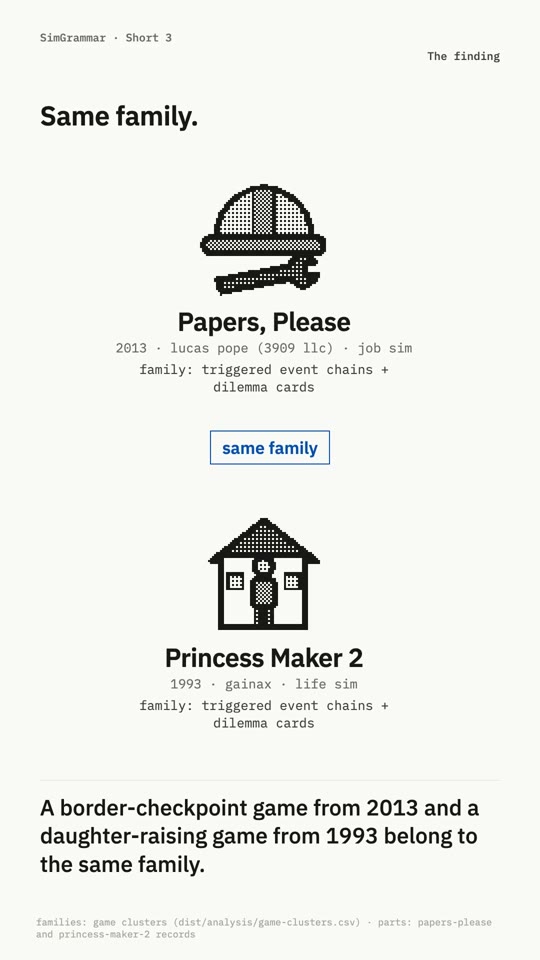 play · 0:36
short 3 0:36
A border post and a daughter
transcript
A border-checkpoint game from 2013 and a daughter-raising game from 1993 belong to the same family.
We grouped 179 simulation games by the parts they're built from, then redid the grouping on 1000 random subsets of the catalog. These two land together almost every time.
Both give you time in fixed slots: a shift at the border, three slots a month for your daughter. Both keep money tight. Both keep sending authored events at you.
Princess Maker 2 is filed as a life sim, and it lands far from The Sims.
also on the pages for
 Treasury and budget
 Care-dependent development
 Daily action budget
 Lifecycle and aging
 Needs decay
 Rule-checking inspection
 Triggered event chains
 Career ladder
 Building placement
definition
Each agent holds an experience stock and level per skill. Doing a task adds experience at a rate scaled by learning modifiers; crossing thresholds raises the level, and some games decay unused high levels. Level feeds work speed, success or botch chance, output quality, and minimum-level gates. RimWorld uses levels 0-20; experience to the next level rises from 1,000 at level 0 to 30,000 at level 19; passion sets learning to 35% (none), 100%, or 150%; skills above 9 decay by 30 to 3,600 XP per day; a daily cap of 4,000 XP per skill cuts further gains to 20%; construction speed is 50% plus 15% per level; some backstories make pawns incapable of a work type. The Sims raises skills through objects such as bookshelves and easels and gates promotions on them; Dwarf Fortress dwarves improve by repeating labors. Inputs: task time, learning modifiers. Outputs: speed, quality, eligibility for tasks.
player experience
Agents become individuals with track records. The player assigns specialists, trains newcomers on low-stakes work, and feels the loss when a master crafter dies. Skill growth gives each character a slow progression arc that runs alongside the base's growth.
design levers
- experience curve shape and level cap
- learning-rate modifiers such as passions, traits, age, and teachers
- decay of unused skills and daily learning caps
- effect curves per level on speed, quality, and failure chance
- hard gates (minimum level, incapable) versus soft penalties
failure modes
- Uncapped or linear growth turns every long-lived agent into a master, flattening differences between characters.
- Grinding: players set agents to repeat cheap tasks to farm experience, which RimWorld counters with a daily learning cap.
- Steep effect curves make low-skill recruits useless, so new agents are dead weight rather than trainees.
- Decay without clear feedback reads as random loss of competence.
dynamics
- Specialization snowballs: the best agent at a job gets assigned it, which raises that skill further and widens gaps.
- Losing a specialist opens a capability hole that forces retraining or recruitment; with permadeath this is a common crisis.
- Coupled with quality tiers, item value depends on who made it, so assignment becomes an economic decision.
open questions
- Can skills be represented as learned competence (policies that actually improve) rather than numeric multipliers, and does that change player attachment?
- Which decay and cap settings keep specialization meaningful without rewarding grinding?
ratings
12 from named runs; stored scores are their lower medianoriginal score
Practice improving competence and higher skills improving output are intuitive. Decay, passion and caps cause occasional surprises, excluding 5; the basic progression and specialization model does not require deliberate investigation (3).
original score
Specialization reinforces assignments, changes economic quality, and makes specialist death a capability crisis. These are cross-system chains beyond isolated interactions (3), but skills alone are not a primary story engine wherever used (5).
original score
Experience curves, task modifiers, gates and level effects are small tables. They require more than content-free rules (1), without bespoke assets for every skill level or progression variant (3).
original score
Experience accumulation, threshold checks and decay scale linearly over agent skills with modest constants. At colony scale this exceeds negligible one-value bookkeeping (1), but it is not a usual slowdown source (3).
original score
Small growth or output-curve changes can make grinding optimal, specialists snowball or recruits useless. That dominant-strategy sensitivity exceeds ordinary multi-parameter tuning (3), while caps, decay and soft gates can settle balance below 5.
original score
AI can assist experience curves, training advice and balance checks, incremental changes above little expected impact (1). It does not materially change the stock-level-task-effect mechanic or its variety enough for 3.
appears in
the paper, 2 sections · 1 chapter · 2 episodes · 1 shortrelations
3 stored edges Quality tiers
Skilled workers produce higher-quality goods.
 Staff hiring and rosters
Hiring trades wage cost against skill, and skills grow with time on the roster.
 Work priorities
Priorities route skilled agents to the jobs they do best.
 LLM-written skill libraries (Voyager)