
budget-treasury mechanic sourced
Treasury and budget
A money stock with income and expense flows such as taxes, upkeep, wages, and service funding; a negative balance leads to debt or failure.
watch
1 short with this record on screen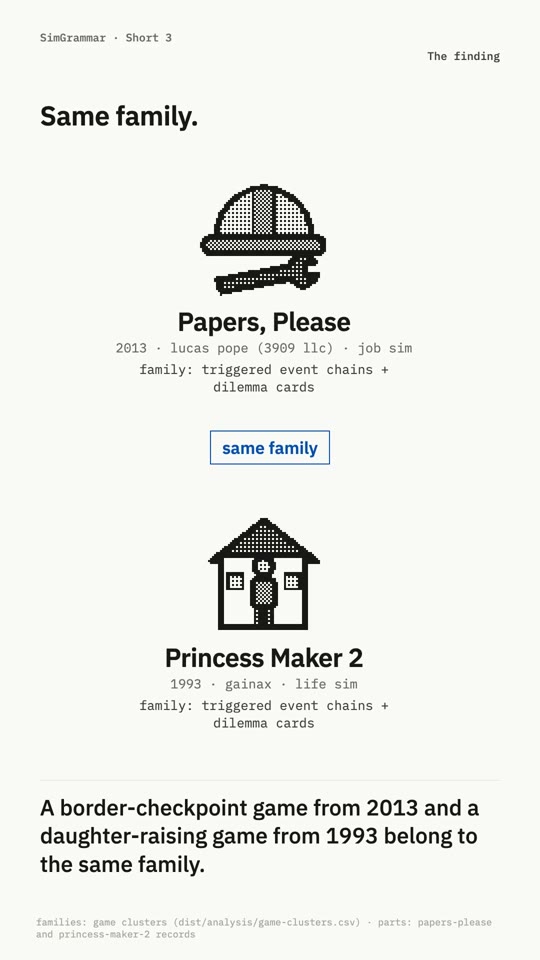 play · 0:36
short 3 0:36
A border post and a daughter
transcript
A border-checkpoint game from 2013 and a daughter-raising game from 1993 belong to the same family.
We grouped 179 simulation games by the parts they're built from, then redid the grouping on 1000 random subsets of the catalog. These two land together almost every time.
Both give you time in fixed slots: a shift at the border, three slots a month for your daughter. Both keep money tight. Both keep sending authored events at you.
Princess Maker 2 is filed as a life sim, and it lands far from The Sims.
also on the pages for
 Agent skills
 Care-dependent development
 Daily action budget
 Lifecycle and aging
 Needs decay
 Rule-checking inspection
 Triggered event chains
 Career ladder
 Building placement
definition
Owns one money stock and a ledger of flow categories. Each accounting period income (taxes, fees, sales, trade) is added and expenses (upkeep, wages, service funding, interest) are subtracted. Players often set a funding fraction per department, and service effectiveness scales with it. In Micropolis, the open-source SimCity engine, the collection every 48 city-time steps computes revenue = population x average land value / 120 x tax rate x a difficulty factor, sets required police and fire funds at 100 per station and road funds per road and rail tile, and converts the fraction actually paid into RoadEffect (0-32) and PoliceEffect and FireEffect (0-1000), so underfunded roads decay and coverage shrinks. A negative balance leads to loans, bonds, bankruptcy, or game over; SimCity 2000 ends the game after extreme deficit spending.
player experience
Periodic reckoning. The player watches a running balance and a monthly or yearly ledger, trims service budgets to stay solvent, and decides when a surplus should become new construction. Shortfalls show up as visible decay: crumbling roads, slower fire response, unpaid staff.
design levers
- accounting period length and whether flows post continuously or at fixed ticks
- which expense categories are player-adjustable and how effectiveness scales with the funding fraction
- upkeep per building relative to the revenue it enables
- consequence of a negative balance (borrowing, forced cuts, bankruptcy, or game over)
- how much ledger detail and forecasting the interface shows
failure modes
- Upkeep that scales slower than revenue makes money irrelevant by mid-game, a common complaint about Cities: Skylines.
- Funding sliders whose effects are delayed or hidden teach players to cut services without visible cost until a collapse.
- Fixed upkeep with no link to growth produces an early cash trap with no recovery path.
dynamics
- Surpluses fund expansion that raises both revenue and upkeep, so cash pressure returns at each growth stage.
- Underfunding one service degrades a dependent system (roads, crime, fires), which later lowers the revenue base.
- Periodic settlement creates sawtooth cash curves and end-of-period scrambles.
open questions
- Can an LLM advisor explain a deficit as a causal chain through the ledger well enough to replace spreadsheet-style budget panels?
- What upkeep-to-revenue curve keeps money a meaningful constraint into the late game?
appears in
the paper, 2 sections · 1 chapter · 2 episodes · 1 shortrelations
1 stored edges Loans and debt
Debt extends the treasury in time, trading future flexibility for present growth.
 Taxation