
variable-speed mechanic sourced
Pause and speed control
The player pauses the simulation and switches between speed multipliers, trading attention against elapsed game time.
watch
2 shorts with this record on screen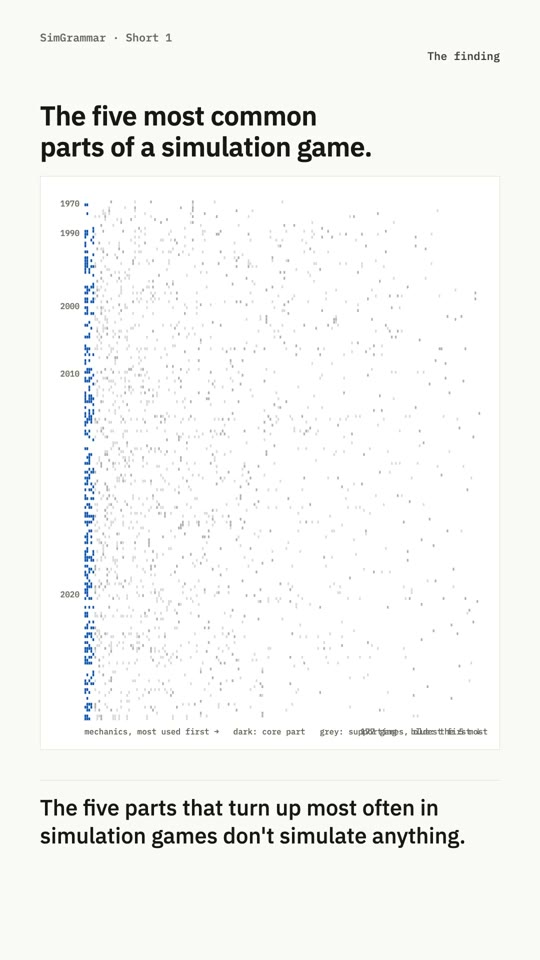 play · 0:38
short 1 0:38
The five most common parts
transcript
The five parts that turn up most often in simulation games don't simulate anything.
We broke 179 of them into their parts. First is the pause button, in 46 percent of them. Then placing buildings where you like, support for mods, a tech tree, and scenario goals.
Production chains come sixth, and they're the first part on the list that models something in the world: ore into plates, plates into gears.
The parts a game is known for are rare. RimWorld's storyteller, its mood breaks and its body-part injuries each show up in fewer than ten catalog games.
also on the pages for
 Building placement
 Modding API
 Scenario objectives
 Tech tree
 Injury body model
 Mood and breakdowns
 Storyteller director
 Production chains
 play · 0:33
short 12 0:33
The parts the agents skipped
transcript
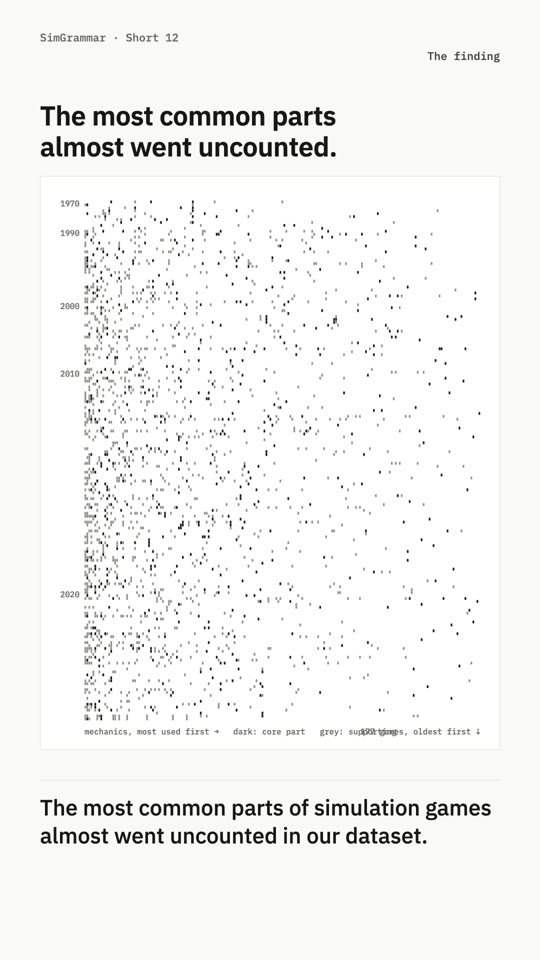
The most common parts of simulation games almost went uncounted in our dataset.
The first catalog was built by AI agents working in parallel. Each one recorded the parts that made a game distinctive and skipped the obvious ones: the pause button, placing buildings, tech trees. An outside review caught it.
Once the gaps were filled, the pause button turned out to be the most common part of all, in 46 percent of the catalog. Now every number in this series is checked against the data each time it's built.
also on the pages for
definition
Owns a time scale, paused or one of several multipliers, and the rule that converts real time into simulation ticks. At higher speeds the loop runs more ticks per real second up to hardware limits; while paused no ticks run but the player can still give orders. Some games pause or slow automatically on events. RimWorld runs 60 ticks per second at normal speed and multiplies that by 3, 6, or 15, the last only in development mode, and runs as close to the target as the machine allows; SimCity and Paradox grand strategy games offer pause and several speeds; flight simulators call it time compression. Inputs are the player's speed choice and event triggers; outputs are the tick rate of every other system.
player experience
Control over attention. The player slows down or pauses for crises and detailed orders, then fast-forwards through quiet stretches such as waiting for crops or construction. Pause makes real-time games playable at a thoughtful pace, and fast-forward removes dead time.
design levers
- number of speeds and their multipliers
- whether orders can be given while paused
- auto-pause and auto-slowdown triggers, such as raids or letters
- speed restrictions in multiplayer or during events
- whether higher speeds change simulation fidelity, such as larger time steps
failure modes
- High speeds the hardware cannot sustain silently run slower than shown, so late-game fast-forward feels broken.
- Larger time steps at high speed can destabilize physics or give different outcomes than normal speed.
- Multiplayer games must reconcile players' speed preferences, often by host control or voting.
dynamics
- Players alternate between paused planning and fast-forward waiting, creating a two-tempo play pattern.
- Fast-forward exposes the compute cost of every other system, making simulation performance a gameplay issue.
- Auto-pause rules decide which events players notice.
open questions
- Can learned surrogate simulators let players skip long quiet stretches without running full-fidelity ticks?
appears in
the paper, 2 sections · 1 chapter · 5 episodes · 2 shortsFamilies across genres
on screen at 3:38 odd couples, 5:20 the sequel that moved, 7:31 close
 Embodied skill control
 Persistent shared world
 Real-time clock