mood-breakdown mechanic sourced
Mood and breakdowns
Mood aggregates needs, memories, and environment, and crossing thresholds triggers mental breaks or inspired performance.
watch
1 short with this record on screen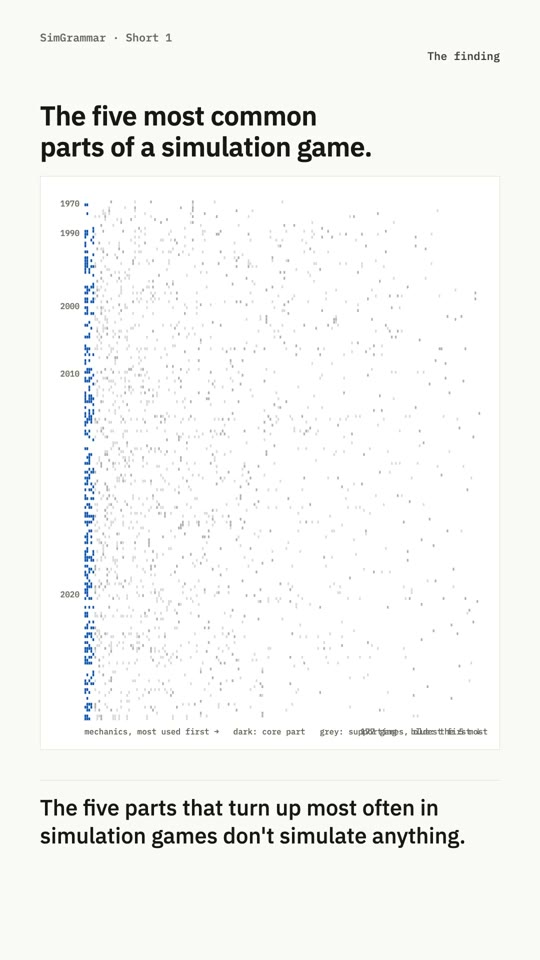 play · 0:38
short 1 0:38
The five most common parts
transcript
The five parts that turn up most often in simulation games don't simulate anything.
We broke 179 of them into their parts. First is the pause button, in 46 percent of them. Then placing buildings where you like, support for mods, a tech tree, and scenario goals.
Production chains come sixth, and they're the first part on the list that models something in the world: ore into plates, plates into gears.
The parts a game is known for are rare. RimWorld's storyteller, its mood breaks and its body-part injuries each show up in fewer than ten catalog games.
also on the pages for
 Building placement
 Modding API
 Scenario objectives
 Tech tree
 Pause and speed control
 Injury body model
 Storyteller director
 Production chains
definition
Owns a per-agent mood value equal to a baseline plus the sum of active modifiers (needs, memories, environment, traits), usually smoothed toward that target, and a set of thresholds. While mood sits below a threshold a hazard rate rolls for a break whose severity rises with depth; during a break the agent leaves player control. High mood can roll for positive states. RimWorld: base mood 22 to 42 by difficulty; the bar moves toward its target at up to +12 per hour rising and -8 falling; break thresholds are 35%, 20%, and 5% (traits shift the minor one, capped 1-50%), with mean times between breaks of about 4, 0.8, and 0.5 days; above 49% mood, inspirations arrive with a mean interval of 410 - 400 x mood days and grant effects such as x1.8 work speed for 8 days. Dwarf Fortress keeps a hidden stress value, scaled by personality facets, that can end in tantrums or depression. Inputs: needs, memories, traits. Outputs: lost labor, destructive acts, temporary buffs.
player experience
The player manages risk rather than events: watching mood bars near thresholds, removing stressors, and bracing when a disaster pushes several agents under at once. Breaks are memorable because they are partly random and partly the player's fault.
design levers
- baseline per difficulty and weights of each mood input
- threshold levels and trait offsets
- hazard rate per band and severity table
- break catalog (sad wander, binge, tantrum, violence) and whether breaks harm others
- chance and size of positive states at high mood
failure modes
- Cascades: one break creates negative memories in witnesses, and the group spirals beyond recovery after a random event, which feels unfair.
- Mood that is easy to max removes the system from mid and late game.
- Breaks that destroy hours of work feel punitive rather than dramatic.
- Opaque mood sources make breaks feel random.
dynamics
- Breakdown contagion: breaks generate negative memories in witnesses that lower their mood, a reinforcing loop.
- Players build mood infrastructure (recreation, beauty, fine meals) as defense, coupling mood to the economy.
- Inspirations reward stable groups with bursts of output, so content colonies pull further ahead.
open questions
- Can breaks be generated as character-specific behavior by language-model agents instead of drawn from a fixed catalog, and still be legible?
- What hazard shape keeps breaks dramatic without producing unrecoverable cascades?
appears in
the paper, 2 sections · 5 episodes · 1 shortEvery simulation game is made of the same parts
on screen at 0:00 cold open, 0:32 rimworld, in parts, 1:23 rare parts
Families across genres
on screen at 4:07 odd couples, 4:58 series and descendants, 7:31 close
Why deep systems are hard to read
on screen at 0:27 the chain you cannot see, 5:51 choosing a point
relations
1 stored edges Needs decay
Unmet needs feed mood; breakdowns make neglect dramatic instead of a silent efficiency loss.
 Memories and thoughts