
scenario-objectives mechanic sourced
Scenario objectives
Preset maps or situations come with explicit goals, constraints, and often a deadline.
watch
1 short with this record on screen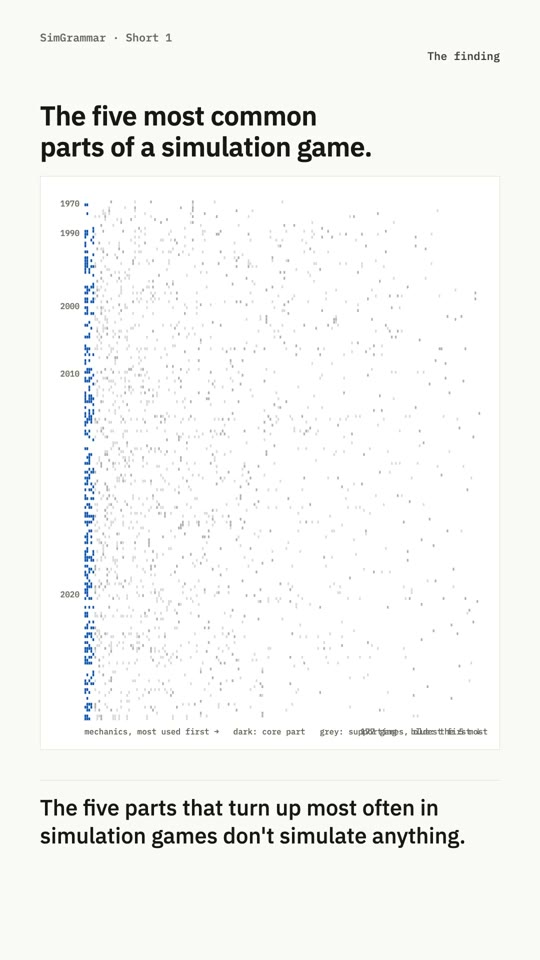 play · 0:38
short 1 0:38
The five most common parts
transcript
The five parts that turn up most often in simulation games don't simulate anything.
We broke 179 of them into their parts. First is the pause button, in 46 percent of them. Then placing buildings where you like, support for mods, a tech tree, and scenario goals.
Production chains come sixth, and they're the first part on the list that models something in the world: ore into plates, plates into gears.
The parts a game is known for are rare. RimWorld's storyteller, its mood breaks and its body-part injuries each show up in fewer than ten catalog games.
also on the pages for
 Building placement
 Modding API
 Tech tree
 Pause and speed control
 Injury body model
 Mood and breakdowns
 Storyteller director
 Production chains
definition
A scenario bundles an initial state (map, buildings, budget, population, problem) with a goal predicate, optional constraints (banned buildings, fixed budget, no loans), and a deadline. State owned: the scenario definition and evaluation status. Update rule: each evaluation interval, test the goal and failure predicates; on the deadline or a failure condition, end with win or loss and often unlock the next scenario. Canonical forms: SimCity (1989), whose goal-oriented, time-limited scenarios were added at Broderbund's suggestion to make the toy more like a traditional game; RollerCoaster Tycoon, whose 21 base scenarios each unlock the next on completion, typically requiring a guest count and park rating by a date; Railroad Tycoon II's bronze, silver, and gold goal tiers; and Theme Hospital levels and Planet Coaster career scenarios.
player experience
The sandbox gets a question. The player studies an inherited mess, plans against the clock, and feels accomplishment rather than open-ended satisfaction. Constraints force use of systems the player would otherwise ignore.
design levers
- goal type: target value, survival, or rescue
- deadline length
- constraints and starting resources
- single goal versus tiered bronze, silver, gold goals
- scenario ordering and unlocks
- whether play continues after the goal is met
failure modes
- Goals that reward a degenerate strategy, such as a guest count met by trapping guests in the park.
- Deadlines that leave no room for experimentation make scenarios feel like puzzles with one answer.
- Initial states that are trivially fixable or hopeless.
dynamics
- Scenarios function as structured tutorials for systems hidden in sandbox mode.
- Hard scenario lines become community challenges with shared strategies.
- Inherited problem cities expose systemic interactions the player did not cause.
open questions
- Can scenarios be generated by searching initial states and constraints for a target difficulty using automated RL playtests?
- Can a language model generate a scenario brief and constraints from a real-world event that the simulation can actually evaluate?
appears in
the paper, 3 sections · 3 chapters · 3 episodes · 1 shortbacklinks
computed from other records Agent-based automated playtesting and balancing
 Automated generation of game rules and mechanics
 Prompt-to-persistent 3D world generation
 Learned level and map generation (PCGRL, MarioGPT, LLM generators)
 Open-ended co-generation of environments and agentsQuality-diversity search (MAP-Elites) for content and balance
claims
2 with sourcesSimCity (1989) included goal-oriented, time-limited scenarios that end in win or loss; Broderbund suggested scenarios to make SimCity more like a traditional game.
RollerCoaster Tycoon, designed and programmed by Chris Sawyer, shipped with 21 scenarios in which completing one unlocks the next.