rollercoaster-tycoon game sourced
RollerCoaster Tycoon
An amusement park management game in which the player builds rides and custom coasters piece by piece, rated for excitement, intensity, and nausea, to satisfy guests with individual preferences and meet scenario goals.
parts
20 mechanics, as RollerCoaster Tycoon does themcore · 5

Crowd preferences
Guests have money, a preferred ride intensity, a nausea tolerance, and needs, and they report thoughts such as a ride being too intense or a price too high.
Customer value choice
Guests compare ride and shop prices with ride value and their remaining cash; overpriced items show up as complaints in guest thoughts.
Design performance rating
Each ride is test-run and rated on excitement, intensity, and nausea from its track geometry, speeds, and g-forces; ratings set demand and fair price.
Modular assembly
Coasters are built track piece by piece on a tile grid, choosing direction, height, steepness, and elements such as loops and corkscrews.

Wear and breakdown
Ride reliability decays with use and age; breakdown chance rises as reliability falls, and mechanics inspect and repair on a set interval.
supporting · 15

Advertising and awareness
The marketing panel runs time-limited paid campaigns, such as park or ride advertising and free-entry or half-price vouchers, that raise guest arrivals or demand for a chosen ride or stall while they last.

Agent inspection
Clicking a guest shows cash, needs, thoughts, and ride history.

Agent pathfinding
Guests navigate the path network and can get lost in mazes of paths.

Building placement

Decoration and beauty
Scenery and trees improve guest views and ride appeal.
Loans and debt
Parks start with a loan, such as $50,000 in Mega Park.

Needs decay
Guests get hungry, thirsty, tired, and need toilets during a visit.

Pause and speed control

Scenario objectives
Each of 21 base scenarios sets a goal such as a guest count with a minimum park rating by a deadline; completing one unlocks the next.
Service queues
Guests wait in ride queues and leave long lines unhappy.
Staff hiring and rosters
Handymen sweep, empty bins, and mow; mechanics fix rides; security guards prevent vandalism; entertainers cheer guests.

Tech tree
Paid research unlocks new rides and improvements over time.
Terraforming
Land can be raised and lowered and water added to fit rides and add appeal.
Track laying
Coaster track is built piece by piece on the tile grid by direction, height, steepness, and elements such as loops and corkscrews, and the result is rated by test run.

Utility action selection
watch
1 short with this record on screen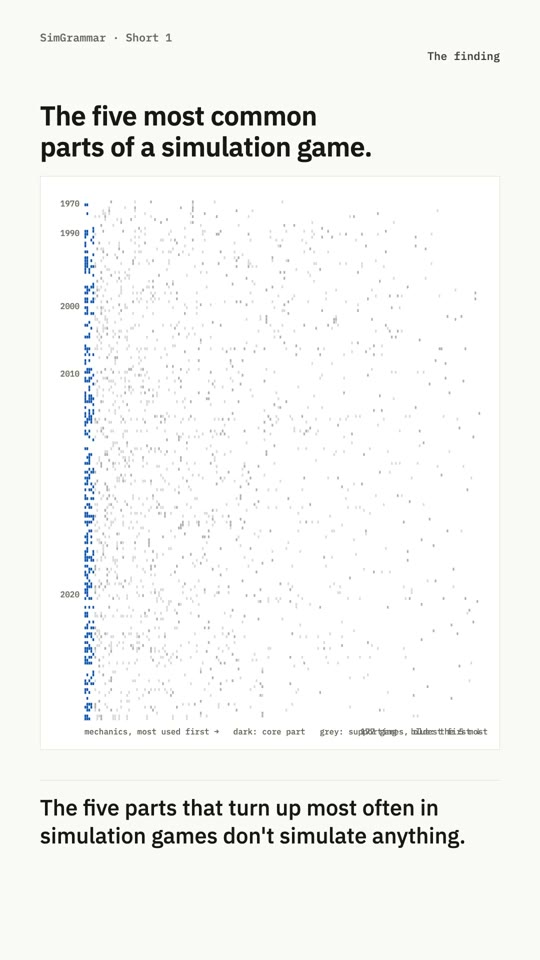 play · 0:38
short 1 0:38
The five most common parts
transcript
The five parts that turn up most often in simulation games don't simulate anything.
We broke 179 of them into their parts. First is the pause button, in 46 percent of them. Then placing buildings where you like, support for mods, a tech tree, and scenario goals.
Production chains come sixth, and they're the first part on the list that models something in the world: ore into plates, plates into gears.
The parts a game is known for are rare. RimWorld's storyteller, its mood breaks and its body-part injuries each show up in fewer than ten catalog games.
also on the pages for
 Modding API
 Injury body model
 Mood and breakdowns
 Storyteller director
 Production chains
core loop
build paths, rides, and shops -> design coasters and test their ratings -> guests choose rides by intensity preference and budget -> thoughts reveal problems -> adjust prices, staff, and layout -> meet the scenario goal
design notes
RollerCoaster Tycoon makes ride design measurable: every built ride is test-run and rated on excitement, intensity, and nausea, and each guest has a preferred intensity and a nausea tolerance, so the ratings decide who will ride and who gets sick afterward. Guests are individual agents with money, needs, and a stream of readable thoughts, which makes park problems inspectable one guest at a time. Rides lose reliability with age and break down unless mechanics inspect them on a player-set interval. Scenario goals (guest counts and park rating by a deadline) chain 21 base parks. OpenRCT2, a reimplementation of RCT2, carries the systems forward, and Planet Coaster and Parkitect are described as spiritual successors.