
production-chain mechanic sourced
Production chains
Buildings or machines convert input goods into output goods via fixed recipes and cycle times, forming multi-step dependency trees.
watch
2 shorts with this record on screen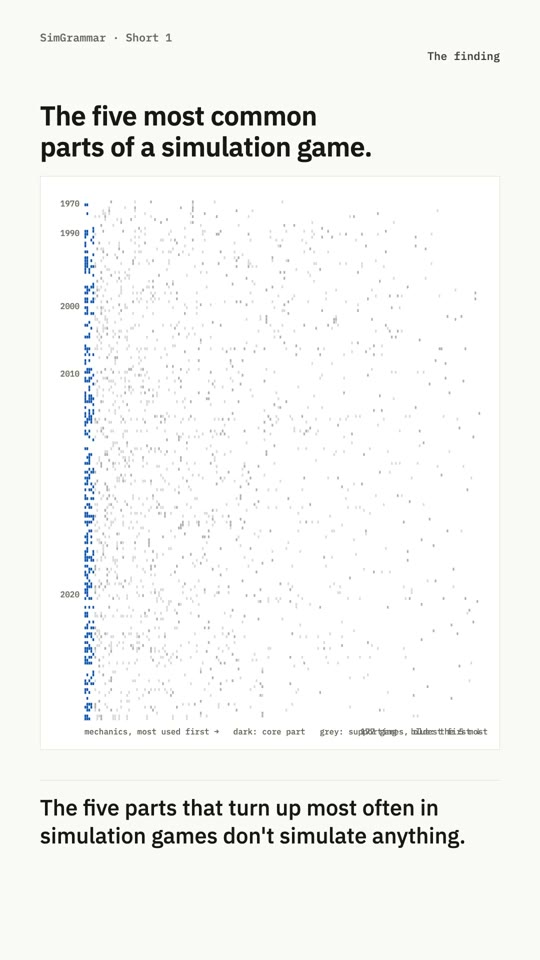 play · 0:38
short 1 0:38
The five most common parts
transcript
The five parts that turn up most often in simulation games don't simulate anything.
We broke 179 of them into their parts. First is the pause button, in 46 percent of them. Then placing buildings where you like, support for mods, a tech tree, and scenario goals.
Production chains come sixth, and they're the first part on the list that models something in the world: ore into plates, plates into gears.
The parts a game is known for are rare. RimWorld's storyteller, its mood breaks and its body-part injuries each show up in fewer than ten catalog games.
also on the pages for
 Building placement
 Modding API
 Scenario objectives
 Tech tree
 Pause and speed control
 Injury body model
 Mood and breakdowns
 Storyteller director
 play · 0:36
short 7 0:36
Most used, barely touched
transcript
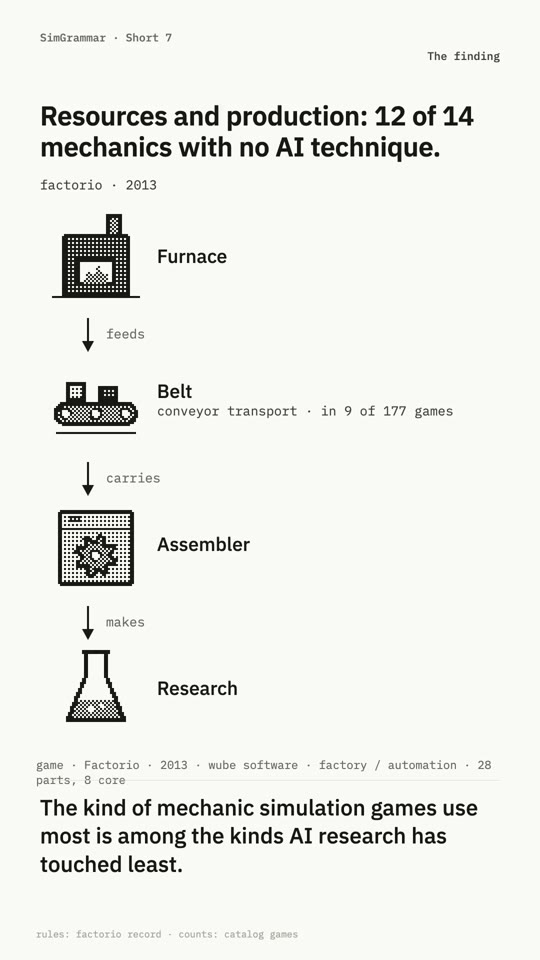
The kind of mechanic simulation games use most is among the kinds AI research has touched least.
Resources and production is the most used family in our catalog. Of its 14 mechanics, 12 have no AI technique pointed at them, production chains included.
A furnace starves far upstream, and the player blames the building in front of them. The record for production chains lists that as a known failure in games without flow statistics.
Instead the techniques pile up on stories and characters. Narrative and generation is the most exposed family in the set.
also on the pages for
 Conveyor transport
definition
Each producer holds a recipe (input amounts, output amounts, cycle time), an input buffer, an output buffer, and a progress timer. Each tick, if inputs and power or labor are present and the output buffer has room, progress advances; on completion inputs are consumed and outputs added. Chained producers form a directed graph from raw resources to finished goods whose steady-state throughput is set by recipe ratios and the slowest stage. The Settlers (1993) chains wheat through a mill to a bakery; Anno 1800 gives each building a fixed cycle time so players build in ratios; Factorio and Satisfactory expose rates directly and add alternate recipes, modules, and productivity bonuses. GlassBox, the SimCity (2013) engine, expresses production as rules that move or combine resources held in a unit's bins. Inputs: raw goods, labor, energy. Outputs: intermediate and final goods, plus a blocked or starved state per producer.
player experience
Building machines that build things. The player traces a desired product back through its tree, sizes each stage, and watches for the stage that starves or backs up. Satisfaction comes from a balanced line running unattended; tension comes from every new product adding a branch to an already crowded layout.
design levers
- recipe depth and branching factor of the dependency tree
- cycle times and ratios, and whether they are round numbers players can compute
- alternate recipes and multi-output recipes that create choices
- buffer sizes at inputs and outputs
- modifiers such as modules, worker skill, or productivity bonuses
- how chains are displayed: hidden, per-building stats, or a full production overview
failure modes
- A single optimal ratio per product, once solved, turns play into copying calculator output.
- Deep trees of single-use intermediates add layout work without adding decisions.
- Starvation far upstream is hard to diagnose without flow statistics, so players blame the wrong building.
dynamics
- The slowest stage sets throughput, so the bottleneck moves each time players fix one, creating a chase loop.
- Shared intermediates create contention between chains and force priority decisions.
- Coupled with logistics, layout distance becomes part of the recipe cost.
- Machines that build machines produce exponential factory growth, capped by inputs, space, or threat.
open questions
- Can AI generate recipe graphs that are solvable, non-degenerate, and on-theme, cutting content cost for factory games?
- Do players learn chain design faster from flow visualizations or from AI explanations of bottlenecks?
appears in
the paper, 2 sections · 7 chapters · 6 episodes · 2 shortsWhere the parts came from
on screen at 3:15 the founding games, 7:21 built from older parts
Families across genres
on screen at 0:17 cold open, 0:27 same chain, different games, 3:18 odd couples, 4:44 series and descendants and 1 more
Vacant lots
on screen at 3:19 workers who grow old, 4:03 shared designs, 5:37 lots already built
relations
1 stored edges Storage and buffers
Buffers decouple steps of a chain; their fill levels reveal bottlenecks.
 Power grid