cities-skylines game sourced
Cities: Skylines
A city builder in which road-following zones, agent citizens who route to work along computed paths, district policies, and player-drawn transit lines make traffic flow the central design problem.
parts
17 mechanics, as Cities: Skylines does themcore · 4
Public transit lines
Player-drawn bus, tram, train, metro, ferry, and taxi lines carry passengers, cut congestion, and earn fares.
Road networks
Road type sets lanes, speed, and zone frontage; network geometry such as interchanges and one-way systems decides throughput.

Traffic congestion
Each citizen takes the fastest route to work or other destinations; poor road design shows up as visible jams that delay services and deliveries.
Zoning
Zoning cells follow the shape of drawn roads; residential, commercial, industrial, and office zones develop and level up.
supporting · 13

Agent pathfinding
Citizens and vehicles path individually through roads, paths, and transit.

Building placement

Education and workforce
Elementary (300), high school (1,000), and university (4,500) capacities move citizens through four education levels that higher-level jobs require.

Fluid pipe networks
Water and sewage pipes; sewage released upstream contaminates downstream intakes.

Land value
Services and parks raise land value, pollution and noise lower it, and land value helps buildings level up.
Lifecycle and aging
Citizens age and die; an initial cohort moving in together can age into a wave of deaths that overloads hearses.

Milestone unlocks
Population milestones unlock services, zoning types, policies, and purchase of up to 25 map tiles.

Modding API
Steam Workshop and a mod-friendly architecture; mods add assets, maps, and new behavior.

Pause and speed control

Policy toggles
District policies restrict development types, set district tax rates, or make transit free.

Power grid
Service coverage
Service buildings reach buildings by network distance and dispatch vehicles.

Travel mode choice
Citizens choose between walking, driving, and the player's bus, tram, train, metro, ferry, and taxi lines when routing to destinations, so new lines shift demand off roads.
watch
1 short with this record on screen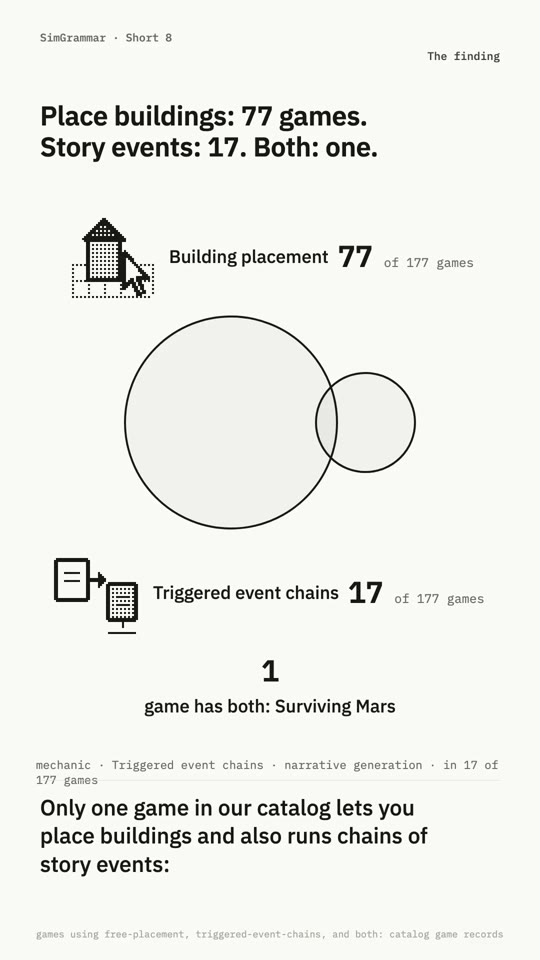 play · 0:38
short 8 0:38
City builders don't tell stories
transcript
Only one game in our catalog lets you place buildings and also runs chains of story events: 77 games do the first, 17 the second.
In Cities: Skylines, a district built all at once grows old all at once. Decades later its residents die in a wave, and the hearses back up. The game treats it as a services problem. Nothing tells you a story about any of them.
The exception is Surviving Mars, which lays authored mysteries like plagues and AI revolts over a colony you lay out yourself. Even there, the mysteries are layered on top of the colony.
also on the pages for
 Triggered event chains
 Tech tree
core loop
draw roads and zone along them -> citizens move in, commute, and shop along computed routes -> population milestones unlock services and map tiles -> set district policies, taxes, and budgets -> fix traffic with road hierarchy and transit -> expand
design notes
Colossal Order carried the road and transit systems of its Cities in Motion series into a full city builder, so every citizen and vehicle is an agent taking the fastest route and congestion is read directly from visible jams. Zoning cells are generated along whatever road geometry the player draws, freeing layouts from a fixed grid, and districts let the player apply policies and tax rates to painted areas. Paradox approved the project after the reception of SimCity (2013), the game was built for Steam Workshop mods, and widely used mods replace core systems such as traffic rules.
appears in
the paper, 3 sections · 9 chapters · 3 episodes · 1 shortrelations
1 stored edgesbacklinks
computed from other recordsclaims
1 with sourcesCities: Skylines is credited with reviving the SimCity style of city builder after SimCity (2013).
src-wikipedia-city-building-game, src-wikipedia-cities-skylines