the-sims game sourced
The Sims
A life sim in which the player builds a house and guides a household of Sims whose decaying motives, personalities, careers, and relationships produce an open-ended domestic story.
parts
15 mechanics, as The Sims does themcore · 3
Building placement
Build and Buy modes freeze time while the player lays walls, floors, and objects on a square tile grid; object quality and layout set how efficiently motives can be met.

Needs decay
Eight motives (Hunger, Comfort, Hygiene, Bladder, Energy, Fun, Social, Room) decay at different rates; low motives drag down mood, and neglect can kill.
Smart objects
Each of the 150-plus base-game objects advertises motive gains (a refrigerator advertises Hunger, a bed Energy), and Sims query the lot's objects to find interactions.
supporting · 12
Agent skills
Cooking, Mechanical, Charisma, Body, Logic, and Creativity rise through objects such as bookshelves, mirrors, and chess tables, and gate promotions.
Autonomy levels
Free will is an option toggle; even with it on, bills, job hunting, exercise, and having children need commands.
Career ladder
Ten career tracks with ten levels each; promotions need skill points and a minimum number of household friends, and change salary and hours.

Decoration and beauty
The Room motive reflects lighting, cleanliness, and decorative value around the Sim.

Pause and speed control

Permadeath
Sims die from neglect or accidents and leave an urn or tombstone; the household continues without them.
Personality traits
Twenty-five personality points are split across Neat, Outgoing, Active, Playful, and Nice, which change preferred activities and social outcomes.
Relationship values
Each pair holds a relationship score moved by interactions and eroding without contact; friend counts feed promotions.
Romance and family
Sims can become partners, marry, and have a baby by explicit command; neglected babies can be taken away by a social worker.

Social exchanges
Talk, joke, compliment, hug, kiss, tease, slap, and similar interactions succeed or fail on relationship, mood, and personality.
Treasury and budget
Every household starts with 20,000 simoleons regardless of size; wages, bills, and purchases set the balance.

Utility action selection
Free will scores advertised interactions against current motive levels so the most depleted motive tends to win; players can cancel queued autonomous actions.
watch
1 short with this record on screen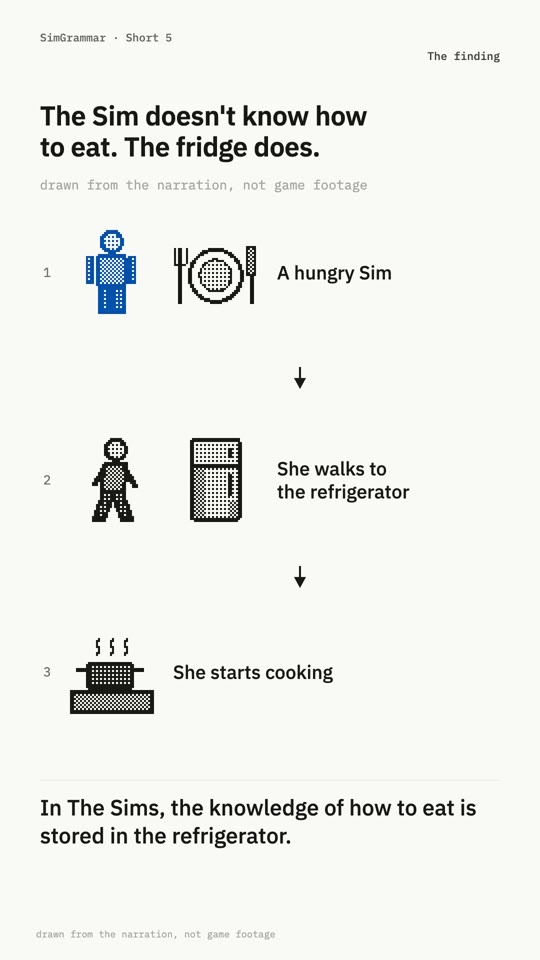 play · 0:36
short 5 0:36
The refrigerator knows
transcript
In The Sims, the knowledge of how to eat is stored in the refrigerator.
Every object advertises what it offers. The refrigerator advertises Hunger, the bed Energy. A Sim weighs the offers in reach against what it needs and picks one, and the object brings the script and the animation [1].
Expansions taught Sims new things largely by selling them new objects.
It also meant every behavior was made by hand. The base game shipped with more than 150 objects, and the dataset scores the method 4 out of 5 for authoring cost.
also on the pages for
core loop
build and furnish the lot -> motives decay -> objects advertise motive gains and Sims act or take queued orders -> jobs pay for upgrades -> skills and friendships unlock promotions -> expand house and family
design notes
Will Wright drew on Christopher Alexander's A Pattern Language, treating a house as a set of functional patterns judged by how well they serve the people living in it. Much of the behavioral logic sits in objects: each object advertises which motives it raises and by how much, and Sims with free will enabled choose among those advertisements weighted by their current motives. Sims are deliberately not fully autonomous, since paying bills, finding jobs, exercising, and having children need explicit commands, so the player alternates between architect and caretaker. Build and Buy modes pause time, separating spatial design from the live simulation.
appears in
the paper, 4 sections · 9 chapters · 8 episodes · 1 shortWhere the parts came from
on screen at 1:08 a date is a lower bound, 4:28 the founding games
The five ceilings
on screen at 0:00 cold open, 0:15 behavior that lives in objects, 5:59 minds made of formulas, 6:27 lifting one ceiling spends another