
modding-api mechanic sourced
Modding API
Hooks for scripts and data definitions, official or through a de facto loader most modders use, let players change and extend the simulation's content and rules.
watch
1 short with this record on screen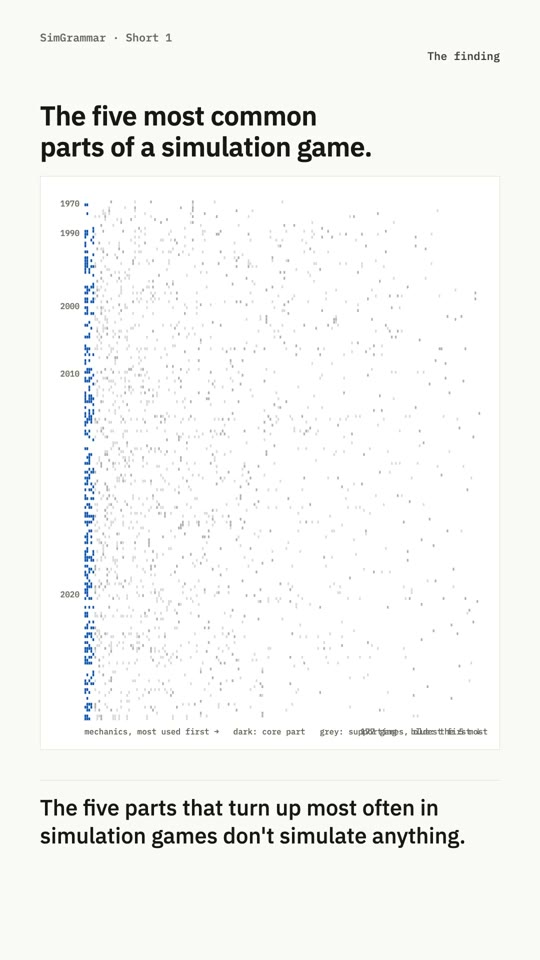 play · 0:38
short 1 0:38
The five most common parts
transcript
The five parts that turn up most often in simulation games don't simulate anything.
We broke 179 of them into their parts. First is the pause button, in 46 percent of them. Then placing buildings where you like, support for mods, a tech tree, and scenario goals.
Production chains come sixth, and they're the first part on the list that models something in the world: ore into plates, plates into gears.
The parts a game is known for are rare. RimWorld's storyteller, its mood breaks and its body-part injuries each show up in fewer than ten catalog games.
also on the pages for
 Building placement
 Scenario objectives
 Tech tree
 Pause and speed control
 Injury body model
 Mood and breakdowns
 Storyteller director
 Production chains
definition
The game exposes two surfaces: data definitions for entities, recipes, and parameters that the engine loads at startup, and a scripting runtime that registers handlers for game events and calls an API to read and change state. Factorio mods use modified Lua 5.2 and pass through settings, prototype (data), and runtime (control) stages in a fixed lifecycle, with the runtime stage event-driven. RimWorld loads XML definitions and C# assemblies; Crusader Kings III exposes event, trigger, and effect scripting; Minecraft's Java Edition relies largely on third-party loaders. A mod manager resolves load order and dependencies. Inputs: mod files. Outputs: changed content, rules, and UI.
player experience
Players reshape the game to their taste, from small fixes to total conversions, and the game keeps renewing years after release. Modders gain a creative outlet and an audience, and non-modders browse mod lists to assemble their own version of the game.
design levers
- surface breadth: data only, data plus scripting, or full code injection
- sandboxing and determinism requirements, such as lockstep multiplayer
- API stability and versioning policy
- load-order and dependency management
- distribution channel and discovery, such as an official mod portal or Steam Workshop
failure modes
- Game updates break mods, and players delay updating or abandon saves.
- Large mod lists conflict and degrade performance in ways that are hard to diagnose.
- Unsandboxed code mods carry security risk to players' machines.
dynamics
- Popular mods become de facto features, and developers later absorb them into the base game.
- Moddable games keep long active communities and sales tails.
- Mods expose and fix balance problems faster than official patches.
open questions
- Can coding models let non-programmers write working mods from natural-language descriptions against a documented API?
- What API design keeps generated mods sandboxed, deterministic, and compatible across updates?
 Content sharing