
tech-tree mechanic sourced
Tech tree
A research or unlock graph gates buildings, recipes, or abilities behind prerequisites and accumulated research.
watch
2 shorts with this record on screen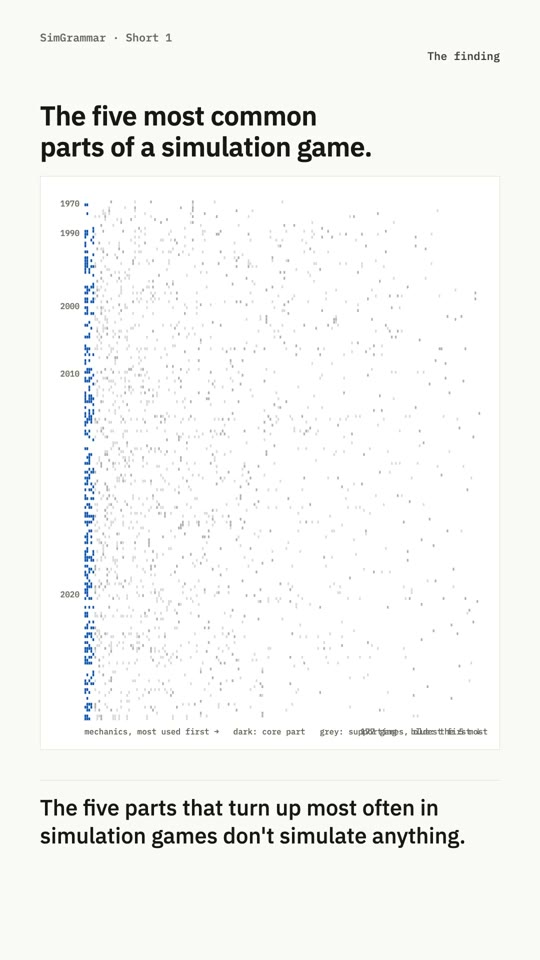 play · 0:38
short 1 0:38
The five most common parts
transcript
The five parts that turn up most often in simulation games don't simulate anything.
We broke 179 of them into their parts. First is the pause button, in 46 percent of them. Then placing buildings where you like, support for mods, a tech tree, and scenario goals.
Production chains come sixth, and they're the first part on the list that models something in the world: ore into plates, plates into gears.
The parts a game is known for are rare. RimWorld's storyteller, its mood breaks and its body-part injuries each show up in fewer than ten catalog games.
also on the pages for
 Building placement
 Modding API
 Scenario objectives
 Pause and speed control
 Injury body model
 Mood and breakdowns
 Storyteller director
 Production chains
 play · 0:38
short 8 0:38
City builders don't tell stories
transcript
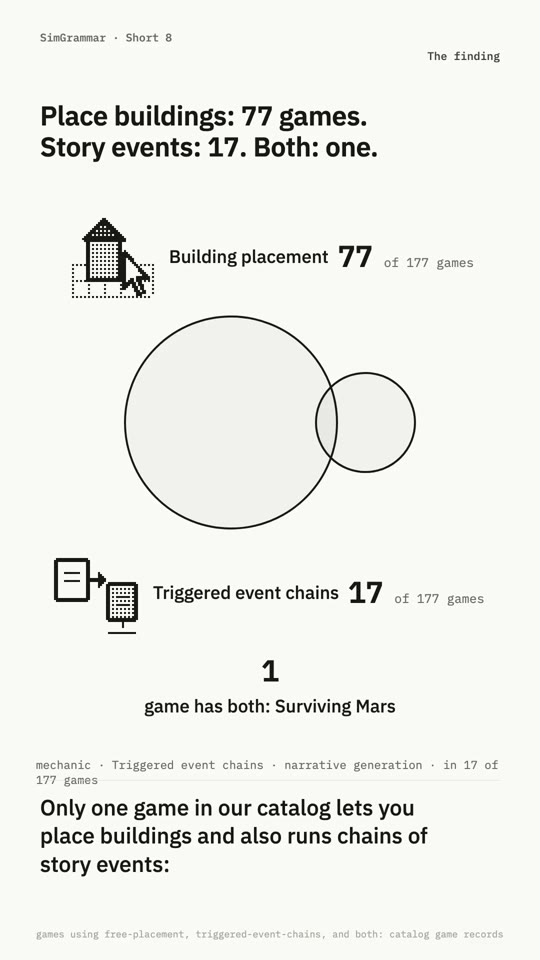
Only one game in our catalog lets you place buildings and also runs chains of story events: 77 games do the first, 17 the second.
In Cities: Skylines, a district built all at once grows old all at once. Decades later its residents die in a wave, and the hearses back up. The game treats it as a services problem. Nothing tells you a story about any of them.
The exception is Surviving Mars, which lays authored mysteries like plagues and AI revolts over a colony you lay out yourself. Even there, the mysteries are layered on top of the colony.
also on the pages for
 Triggered event chains
 Power grid
definition
Technologies are nodes in a directed acyclic graph; each has prerequisites, a research cost, and unlocks. State owned: which techs are researched, current research progress, and queued research. Update rule: each tick or turn, research output (from labs, scientists, or consumed science items) accumulates toward the selected tech; when it reaches the cost, the tech is researched and its unlocks apply. Variants: complete trees where everything is reachable (Civilization), branching trees with exclusive choices, and weighted random draws (Stellaris). Francis Tresham's 1980 board game Civilization is generally credited with introducing the tree, and Sid Meier's Civilization (1991) carried it into video games. Factorio consumes science packs as research input; Stellaris offers three semi-random options per research area, weighted by ethics, scientist traits, and known techs.
player experience
A visible map of future capability. The player plans paths, makes long bets on branches, anticipates key unlocks, and feels progress as a chain of small upgrades toward transformative ones.
design levers
- graph shape: linear, branching, web, or random draws
- cost curve per tier
- research input: abstract points, science items, or scientists
- exclusivity: mutually exclusive branches versus all reachable
- repeatable infinite techs for the late game
- visibility of future nodes
failure modes
- A dominant path that every player follows removes strategic choice.
- Late-tree techs that do nothing useful leave research facilities idle; some players dismantle labs to save upkeep.
- Top techs so strong that the game ends quickly once they are researched, as with the final technologies in Rise of Nations.
- Fully random draws frustrate players who plan, since a needed tech may not appear.
dynamics
- Research pace couples to the economy, so economic snowballing compounds into technological leads.
- Exclusive branches create faction or playstyle identity and replay value.
- In factory games, science items make research a production target, linking progression to logistics throughput.
open questions
- Can a tech tree be generated from the simulation's own physics or chemistry so that research discovers real affordances rather than authored unlocks?
- Can RL agents search tree costs and structures for balance faster than human playtesting?
appears in
the paper, 2 sections · 8 chapters · 4 episodes · 2 shortsWhere the parts came from
on screen at 0:39 a date is a lower bound, 7:21 built from older parts
Families across genres
on screen at 0:17 cold open, 0:27 same chain, different games, 3:50 odd couples, 5:12 series and descendants and 1 more
backlinks
computed from other records Generalist instructable game agents (SIMA)
 Self-play planning with learned models (AlphaZero, MuZero, Dreamer)
claims
2 with sourcesA technology tree is a directed acyclic graph; Francis Tresham's 1980 board game Civilization is generally credited with introducing it, and Sid Meier's Civilization (1991) is the iconic video game example.
Stellaris replaces a fixed tree with three semi-random research options per area, weighted by empire ethics, scientist traits, and known techs, plus rare techs and procedurally generated improvement techs.