lifecycle-aging mechanic sourced
Lifecycle and aging
Agents are born, age through life stages with different capabilities, and die.
watch
1 short with this record on screen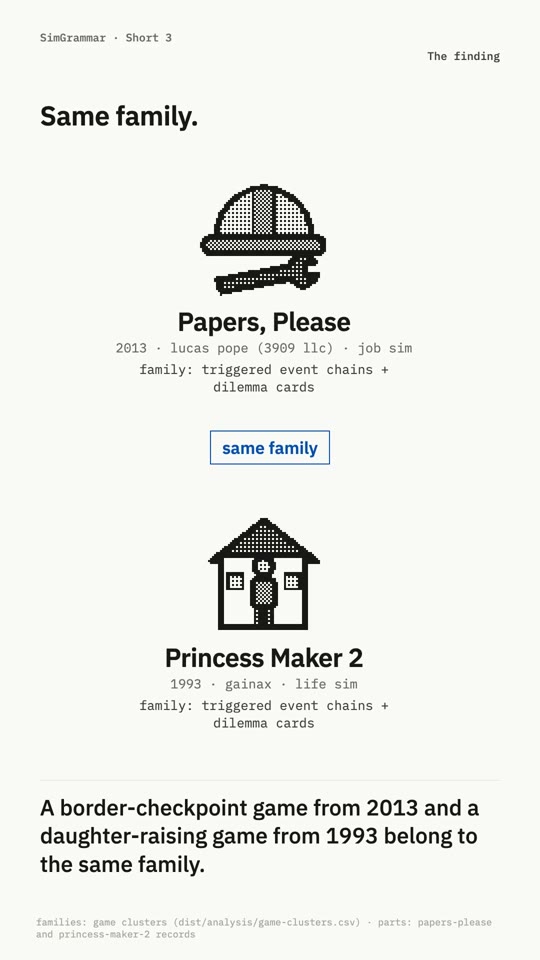 play · 0:36
short 3 0:36
A border post and a daughter
transcript
A border-checkpoint game from 2013 and a daughter-raising game from 1993 belong to the same family.
We grouped 179 simulation games by the parts they're built from, then redid the grouping on 1000 random subsets of the catalog. These two land together almost every time.
Both give you time in fixed slots: a shift at the border, three slots a month for your daughter. Both keep money tight. Both keep sending authored events at you.
Princess Maker 2 is filed as a life sim, and it lands far from The Sims.
also on the pages for
 Agent skills
 Treasury and budget
 Care-dependent development
 Daily action budget
 Needs decay
 Rule-checking inspection
 Triggered event chains
 Career ladder
 Building placement
definition
Owns each agent's age (or an age-structured population count) and a table of life stages with durations, capabilities, needs, and mortality. Each tick age advances; crossing a stage boundary changes what the agent can do (work, marry, study), what it needs, and how it looks; mortality rises with age until death. Births add agents through reproduction rules. The Sims 2 has seven stages (baby, toddler, child, teen, young adult with University, adult, elder): babies become toddlers after 3 Sim days, children become teens after 8, teens live 15 days, adults become elders after 29, and elder lifespan depends on the aspiration meter. Victoria 3 aggregates the same idea: natural growth is birth rate minus mortality, both falling as standard of living rises. Inputs: time, health, birth rules. Outputs: workforce and dependents, deaths, succession and inheritance triggers.
player experience
Time becomes personal: the player watches characters grow up and grow old, plans careers and heirs, and grieves. Aging turns a static roster into a pipeline in which the player raises the next generation of workers.
design levers
- number and duration of life stages relative to the game calendar
- capabilities and needs per stage, such as child labor rules or elder frailty
- mortality curve and whether death is fixed-age or probabilistic
- birth rules and fertility windows
- player controls such as aging toggles and lifespan settings
failure modes
- Lifespans short relative to play pace make characters die before players attach, so games add lifespan settings or aging toggles.
- Demographic echoes: one founding cohort ages together and causes a labor collapse or mass death decades later.
- Children are pure cost with nothing to do, so players avoid births.
dynamics
- Age structure sets dependency ratios that throttle labor and drive housing and school demand.
- Founding cohorts create waves of births, retirements, and deaths that repeat across generations.
- Deaths trigger inheritance, succession, and grief, coupling lifecycle to social and dynastic systems.
open questions
- Can generative models keep a character recognizable across ages in appearance and personality while allowing growth?
- What ratio of lifespan to play pace maximizes attachment and generational play?
appears in
the paper, 2 sections · 1 chapter · 2 episodes · 1 shortrelations
2 stored edges Romance and family
Families form and produce the next generation.
 Trait inheritance
Generations turn over, carrying inherited traits forward.
 Education and workforce