daily-action-budget mechanic sourced
Daily action budget
A per-day pool of energy, stamina, or time slots limits how many actions the player can take, and the day's end resets it and forces prioritization.
watch
2 shorts with this record on screen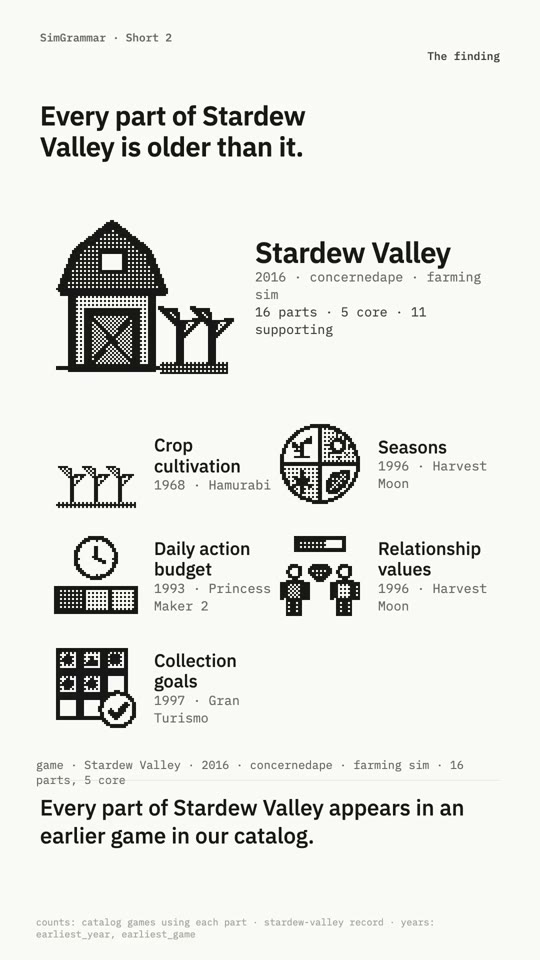 play · 0:40
short 2 0:40
Every part of Stardew Valley is older than it
transcript
Every part of Stardew Valley appears in an earlier game in our catalog.
Crops first appear in Hamurabi, a text game from 1968. A daily action budget first appears in Princess Maker 2, in 1993. Seasons and friendships with villagers first appear in Harvest Moon, in 1996, the game Stardew was built in response to.
That is the norm. Games released since 2010 draw 84 percent of their mechanics from parts that already existed by 2000.
Stardew sets its own numbers: 250 friendship points a heart, and two lost on each day you don't talk to someone.
also on the pages for
 Relationship values
 Crop cultivation
 Seasons
 Collection goals
 Seasonal world reset
 play · 0:36
short 3 0:36
A border post and a daughter
transcript
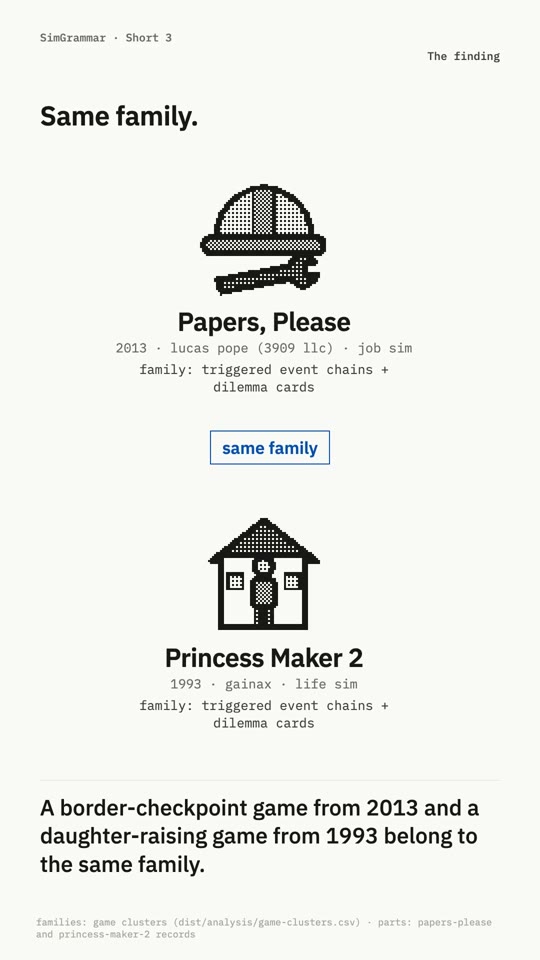
A border-checkpoint game from 2013 and a daughter-raising game from 1993 belong to the same family.
We grouped 179 simulation games by the parts they're built from, then redid the grouping on 1000 random subsets of the catalog. These two land together almost every time.
Both give you time in fixed slots: a shift at the border, three slots a month for your daughter. Both keep money tight. Both keep sending authored events at you.
Princess Maker 2 is filed as a life sim, and it lands far from The Sims.
also on the pages for
 Agent skills
 Treasury and budget
 Care-dependent development
 Lifecycle and aging
 Needs decay
 Rule-checking inspection
 Triggered event chains
 Career ladder
 Building placement
definition
Owns a budget that refills at the start of each in-game day (energy points, stamina, clock hours, or a fixed number of time slots) and a cost per action. Actions spend from the budget; at zero the player is penalized or the day ends, and sleep restores the budget, sometimes less after staying up late. Stardew Valley gives 270 base energy, raised by Stardrops, charges energy for tool use, exhausts the farmer at 0, and makes them pass out at -15 energy or at 2 a.m.; passing out away from home costs 10% of gold up to 1,000g, and going to bed after midnight restores less. Harvest Moon set the stamina-and-clock farm day that Stardew Valley follows; Persona allocates a fixed number of time slots per day to activities. Inputs are action costs and restoration items; outputs are the actions completed per day.
player experience
Every morning is a planning puzzle. The player picks which crops to water, whom to visit, or which job to take, knowing the rest must wait. The end of each day gives a natural stopping point and a sense of steady progress, and upgrades that stretch the budget feel substantial.
design levers
- budget size and whether it grows with progression
- cost per action and which actions are free
- penalties at or past zero and for staying up late
- restoration sources within the day, such as food
- time slots versus a continuous pool
failure modes
- A budget that is too tight early makes the opening a grind; one that grows too fast stops mattering by midgame.
- When one activity has the best return per point, every day becomes the same routine.
- Harsh pass-out penalties push players to reload rather than accept a bad day.
dynamics
- Players batch tasks spatially to save time, which shapes farm and base layout.
- Budget-expanding items become top priorities, forming an upgrade path.
- Automation such as sprinklers frees the budget from chores for new activities, marking progression.
open questions
- Can generated daily events or requests keep each day's allocation decision fresh without hand-authored content?