
triggered-event-chains mechanic sourced
Triggered event chains
Authored event templates fire when state conditions hold, and their outcomes schedule follow-up events that chain into multi-step stories.
watch
2 shorts with this record on screen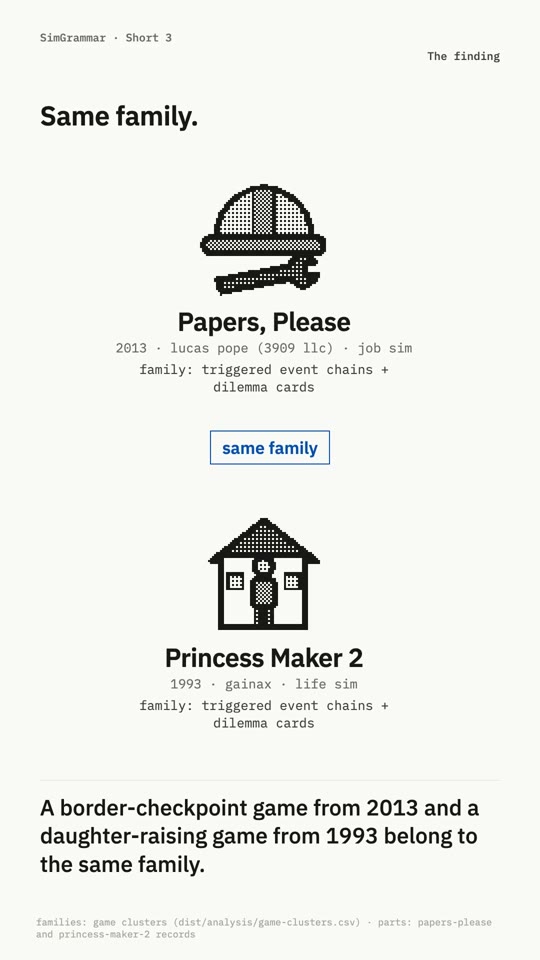 play · 0:36
short 3 0:36
A border post and a daughter
transcript
A border-checkpoint game from 2013 and a daughter-raising game from 1993 belong to the same family.
We grouped 179 simulation games by the parts they're built from, then redid the grouping on 1000 random subsets of the catalog. These two land together almost every time.
Both give you time in fixed slots: a shift at the border, three slots a month for your daughter. Both keep money tight. Both keep sending authored events at you.
Princess Maker 2 is filed as a life sim, and it lands far from The Sims.
also on the pages for
 Agent skills
 Treasury and budget
 Care-dependent development
 Daily action budget
 Lifecycle and aging
 Needs decay
 Rule-checking inspection
 Career ladder
 Building placement
 play · 0:38
short 8 0:38
City builders don't tell stories
transcript
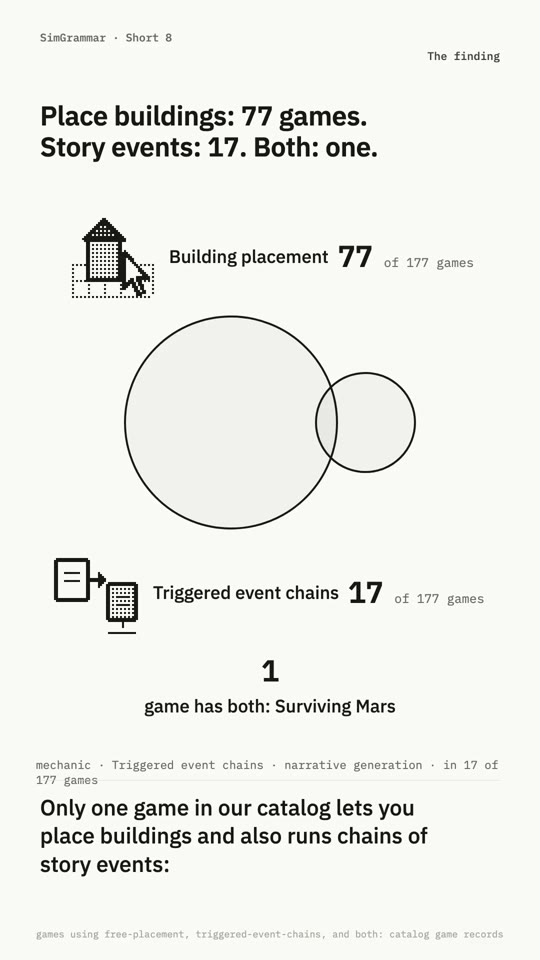
Only one game in our catalog lets you place buildings and also runs chains of story events: 77 games do the first, 17 the second.
In Cities: Skylines, a district built all at once grows old all at once. Decades later its residents die in a wave, and the hearses back up. The game treats it as a services problem. Nothing tells you a story about any of them.
The exception is Surviving Mars, which lays authored mysteries like plagues and AI revolts over a colony you lay out yourself. Even there, the mysteries are layered on top of the colony.
also on the pages for
 Power grid
 Tech tree
definition
Each template holds a trigger predicate over state, a selection weight or mean time to happen, an immediate effect block, options with effects, and calls that schedule follow-up events with delays. Hooks such as yearly pulses, births, or deaths evaluate eligible templates and fire them. In Crusader Kings III, events do not fire on their own: on_actions, decisions, or interactions call them; an on_action can fire a list of events, weighted random_events, or the first valid one; and trigger_event schedules a follow-up such as days = { 7 14 } later, so a chain carries saved scopes and flags across months. Europa Universalis IV and Stellaris use the same Paradox script family; Frostpunk and Banished use simpler condition-fired events. Unlike a storyteller director, which paces generic incidents, chains carry authored story state forward. Inputs: state predicates and flags. Outputs: effects, flags, and scheduled events.
player experience
The simulation seems to notice what the player did. A rival's illness leads to a succession dispute, which leads to a war invitation. Players feel stories unfolding from their situation, learn to set up conditions for chains they want, and dread chains they recognize.
design levers
- trigger specificity: broad pulses versus narrow state predicates
- weights, mean time to happen, and random delay ranges between links
- branching factor and how many chain steps carry state forward
- whether follow-ups re-check conditions so chains can fail when the world changes
- cooldowns and once-per-game flags that limit repetition
failure modes
- Players see the same chains every playthrough once the event pool is exhausted.
- Chains ignore world changes made between links, producing contradictions such as an event about a ruler who has died.
- Broad iteration in frequent pulses (the CK3 modding wiki warns against every_living_character in pulse on_actions) causes late-game slowdown.
- Authored text quality caps depth, because each branch must be written by hand.
dynamics
- Chains link otherwise separate systems, such as health, inheritance, and war, into multi-year storylines.
- Overlapping chains on the same characters produce compound situations that no single template described.
- Modders extend event pools until mods conflict on shared hooks.
open questions
- Can a language model write follow-up links conditioned on the actual state reached, keeping chains coherent with world changes?
- What fraction of authored chain content could be replaced by generated text while keeping effects hand-tuned?
 LLM game master and narrative director
 Story sifting with causal bookkeeping
 Opinion modifiers
 Generative content on demand