generative-decoration-catalogs opportunity asserted
Generative decoration catalogs
Let players generate furniture, scenery, and building pieces from text or sketches within a game's style and technical budgets, removing the cap on creative-mode catalogs.
watch
2 shorts with this record on screen play · 0:39
short 9 0:39
The why button
transcript
The AI feature our dataset ranks highest for simulation games is a button that asks why.
We scored 42 bets on impact, feasibility, and novelty, and this one came first. Right-click the hospital that closed three months ago, ask why, and get a few sentences, each linked to an event in the game's own log. The model can only say what it can point to. If it can't ground an answer, it says so.
The bet has a deadline. If no game with at least ten thousand Steam reviews ships it by December 31, 2027, answering free-text questions from the player's own save, it loses.
also on the pages for
 play · 0:35
short 11 0:35
Due on the same day
transcript
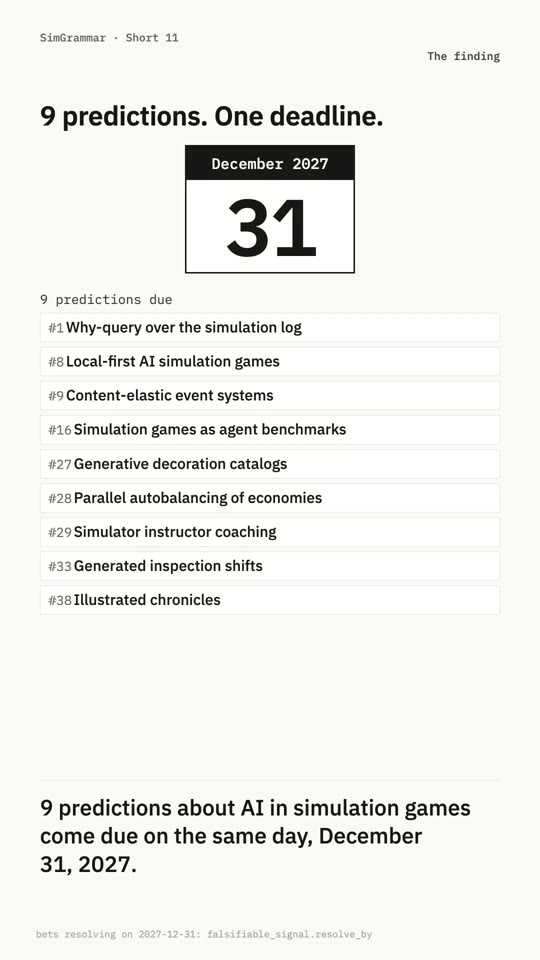
9 predictions about AI in simulation games come due on the same day, December 31, 2027.
Every bet in our dataset carries one, written so a stranger could check it. Take the first: a widely played game lets you ask why something happened in your own save. It only counts if it shipped after October 24, 2026, in a game with ten thousand Steam reviews, answering from your save and not from a manual.
And the person who checks can't be the one who made the bet, or the same AI model that wrote it.
also on the pages for
thesis
Creative-mode sims (The Sims build mode, Planet Coaster scenery, Townscaper-likes) live on catalog breadth, which is bounded by art budgets and DLC schedules. Text-to-3D asset generation reached production use in 2025, and style-constrained pipelines can enforce polygon budgets, collision, and art direction. Generated pieces then feed decoration scores and sharing.
design sketch
A generate button in build mode takes a prompt or sketch, produces three candidates in the game's style, auto-fits collision and placement metadata, and assigns gameplay tags (seating, light, beauty value) from a classifier. Players share pieces with provenance labels.
validation experiment
Generate 200 decor items from player prompts within a game's style guide; have artists rate style match and check technical budgets. Success: 80 percent pass technical budgets and a majority rated on-style.
key risks
- Copyright and trademark in generated pieces.
- Player and press backlash against generated assets.
- Gameplay tags misassigned to generated objects.
falsifiable prediction
A life or management sim other than inZOI will let players generate new placeable 3D objects from text or images.
Feature first shipped after 2026-10-24 in a life or management sim other than inZOI with at least 5,000 Steam user reviews or a console release; store page or patch notes describe player-facing text-to-3D or image-to-3D object generation inside the game.