branch-preview-forecasts opportunity asserted
Branch preview of policy futures
Fork the simulation in the background and show the player likely futures of a decision before committing, using parallel or surrogate simulation.
watch
1 short with this record on screen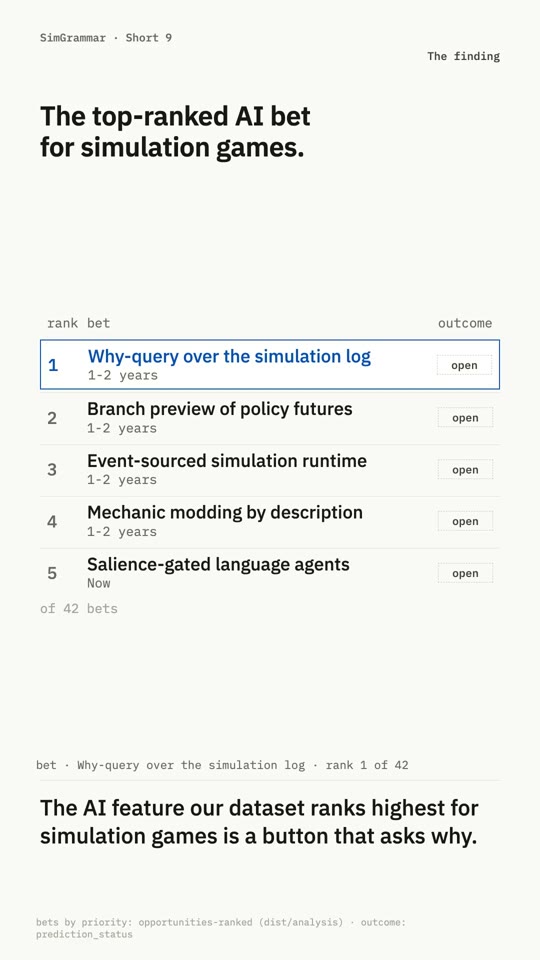 play · 0:39
short 9 0:39
The why button
transcript
The AI feature our dataset ranks highest for simulation games is a button that asks why.
We scored 42 bets on impact, feasibility, and novelty, and this one came first. Right-click the hospital that closed three months ago, ask why, and get a few sentences, each linked to an event in the game's own log. The model can only say what it can point to. If it can't ground an answer, it says so.
The bet has a deadline. If no game with at least ten thousand Steam reviews ships it by December 31, 2027, answering free-text questions from the player's own save, it loses.
also on the pages for
thesis
Forecasting in shipped games is shallow: a runway counter, a weather icon, a predicted approval delta. Accelerated and learned simulators make it cheap to run many short futures of the actual game state. Showing a distribution of outcomes for a pending law, budget, or layout change turns opaque coupling into a visible tradeoff and makes long feedback delays playable. Deterministic, event-sourced simulations can fork from any tick, so the preview runs the real rules rather than a hand-built predictor.
design sketch
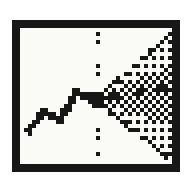
Before enacting a policy the player opens Preview: the game forks 32 to 256 copies from the current tick with stochastic seeds, fast-forwards each one in-game year on spare cores (or a learned surrogate), and shows fan charts for key indicators plus the two most divergent futures as short replays. Preview costs an in-game resource so it remains a decision.
validation experiment
Take a deterministic city or colony prototype, implement state snapshot plus N-way fork, and measure fork-and-simulate cost for one in-game year at mid-game scale. Playtest with preview off and on; measure decision regret (outcome versus best available) and session length. Success: preview of 64 branches under 5 seconds on a mid-range PC and a measurable drop in regret without lower engagement.
key risks
- Previews reveal hidden randomness and can make play feel solved.
- Simulations with large state may not fork cheaply on consumer hardware.
- Surrogate predictions that disagree with the real run break trust.
falsifiable prediction
A city builder, colony sim, or grand strategy game will show players several simulated stochastic futures of their current game state before a decision.
Feature first shipped after 2026-10-24 in a title with at least 1,000 Steam user reviews; store page, patch notes, or a developer talk describes multiple forward runs from the live save state, shown to the player. A single deterministic projection does not count.