parallel-autobalance opportunity asserted
Parallel autobalancing of economies
Run thousands of scripted, learned, and diversity-seeking agents through a game's economy at accelerated speed to find degenerate strategies and tune parameters before players do.
watch
2 shorts with this record on screen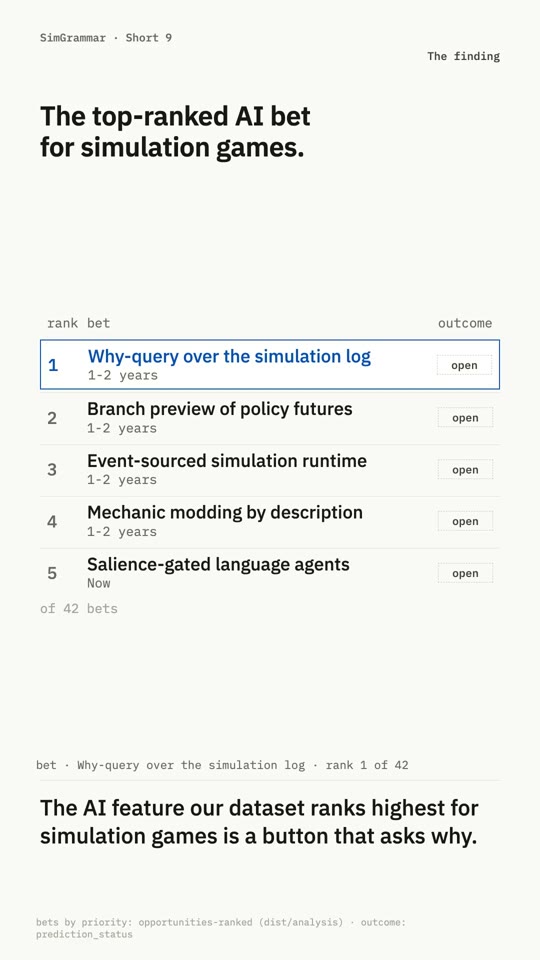 play · 0:39
short 9 0:39
The why button
transcript
The AI feature our dataset ranks highest for simulation games is a button that asks why.
We scored 42 bets on impact, feasibility, and novelty, and this one came first. Right-click the hospital that closed three months ago, ask why, and get a few sentences, each linked to an event in the game's own log. The model can only say what it can point to. If it can't ground an answer, it says so.
The bet has a deadline. If no game with at least ten thousand Steam reviews ships it by December 31, 2027, answering free-text questions from the player's own save, it loses.
also on the pages for
 play · 0:35
short 11 0:35
Due on the same day
transcript
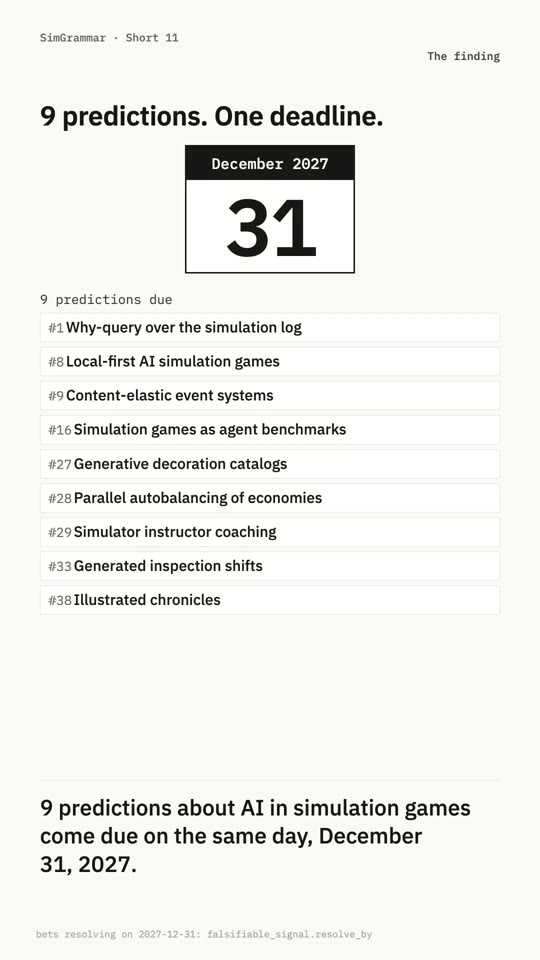
9 predictions about AI in simulation games come due on the same day, December 31, 2027.
Every bet in our dataset carries one, written so a stranger could check it. Take the first: a widely played game lets you ask why something happened in your own save. It only counts if it shipped after October 24, 2026, in a game with ten thousand Steam reviews, answering from your save and not from a manual.
And the person who checks can't be the one who made the bet, or the same AI model that wrote it.
also on the pages for
thesis
Production chains, markets, threat scaling, and tech trees have many interacting parameters and are tuned by small QA teams and patches after launch. GPU-parallel simulation and quality-diversity search make it practical to run very large populations of strategies and to search parameter space for regions with no dominant strategy. This shifts balance work from reactive patching to pre-launch search.
design sketch
A headless build of the simulation runs on a GPU cluster. A quality-diversity search maintains an archive of strategies across behavior descriptors (expansion speed, military share, trade dependence); a tuner adjusts parameters to keep win rates and resource curves inside designer-set bands; reports flag exploits with replays.
validation experiment
Run a MAP-Elites search over strategies in an open-source economy game for one GPU-day and compare discovered exploits with the game's historical patch notes. Success: at least half of historically patched economic exploits rediscovered.
key risks
- Bots find exploits humans never would and miss ones humans find.
- Headless builds of legacy engines are expensive to make.
- Over-balancing removes interesting asymmetries.
falsifiable prediction
At least two studios will publicly describe using large-scale agent search to balance a simulation or strategy game's economy before release.
Talks, technical blogs, or papers published after 2026-10-24 by staff of two different studios, each naming a commercial title with at least 1,000 Steam user reviews and describing automated agent play at scale used for economy balance.