event-sourced-sim-runtime opportunity asserted
Event-sourced simulation runtime
An engine layer that records simulation and model calls as an append-only event log, giving replay, forking, explanation, and determinism for games with AI components.
watch
1 short with this record on screen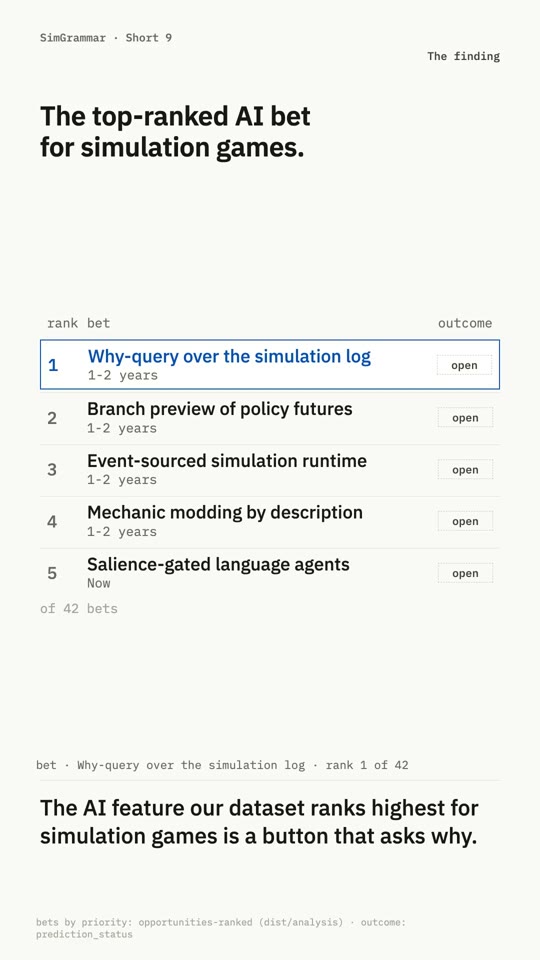 play · 0:39
short 9 0:39
The why button
transcript
The AI feature our dataset ranks highest for simulation games is a button that asks why.
We scored 42 bets on impact, feasibility, and novelty, and this one came first. Right-click the hospital that closed three months ago, ask why, and get a few sentences, each linked to an event in the game's own log. The model can only say what it can point to. If it can't ground an answer, it says so.
The bet has a deadline. If no game with at least ten thousand Steam reviews ships it by December 31, 2027, answering free-text questions from the player's own save, it loses.
also on the pages for
thesis
Most AI-component risks in simulation games are determinism risks: model outputs are not reproducible, so replays, lockstep multiplayer, bug reports, and save integrity break. Recording every model call and its output as an event, and treating the log as the source of truth with state as a projection, restores reproducibility: replays read cached outputs, forks branch from any event, and explanations cite events. The same log feeds why-queries, branch previews, and chronicles.
design sketch
Developers use a runtime where every state change, including those decided by a model, is an event with inputs, outputs, and causes. Replays and multiplayer clients consume logged outputs instead of re-calling models. Tools offer fork-from-here, diff-between-branches, and cause tracing.
validation experiment
Wrap the model calls of an AI-agent prototype in an event log, then replay 100 sessions and verify byte-identical state reconstruction and fork divergence only after the fork point. Success: 100 percent reproducible replays with log overhead under 20 percent of save size per hour.
key risks
- Log size grows quickly in large simulations.
- Retrofitting existing engines is costly.
- Privacy and storage of logged player text.
falsifiable prediction
An engine, middleware vendor, or open-source project will ship an event-log replay and determinism layer designed for games with generative AI components.
Released after 2026-10-24 by any engine or middleware vendor or as an open-source project; documentation describes recording model outputs into a replayable log, and at least one shipped title with at least 1,000 Steam user reviews uses it.