harvest-moon game sourced
Harvest Moon
An early farming sim for the Super Famicom in which the player has two and a half years to restore an inherited farm through daily crop watering, livestock care, and courting one of five eligible women.
parts
8 mechanics, as Harvest Moon does themcore · 3

Animal husbandry
Chickens must be fed and kept indoors or they can die; cows need daily feed, talking, brushing, and milking, and fall sick or die if neglected.

Crop cultivation
Crops need water every day; a missed day halts growth rather than killing the plant, and each crop belongs to a season.

Seasons
A four-season calendar sets which crops can grow and when festivals occur.
supporting · 5

Daily action budget
A stamina pool limits work each day; power berries found around the map raise it.

Day-night cycle
After dark only the bar stays open, so shopping and visits must fit daylight.

Relationship values
Villagers' and candidates' affection rises with talking and gifts.

Romance and family
Five eligible women can be courted; marriage and a child count toward the final evaluation.

Scenario objectives
After two and a half years the father evaluates the farm, family, and relationships.
watch
1 short with this record on screen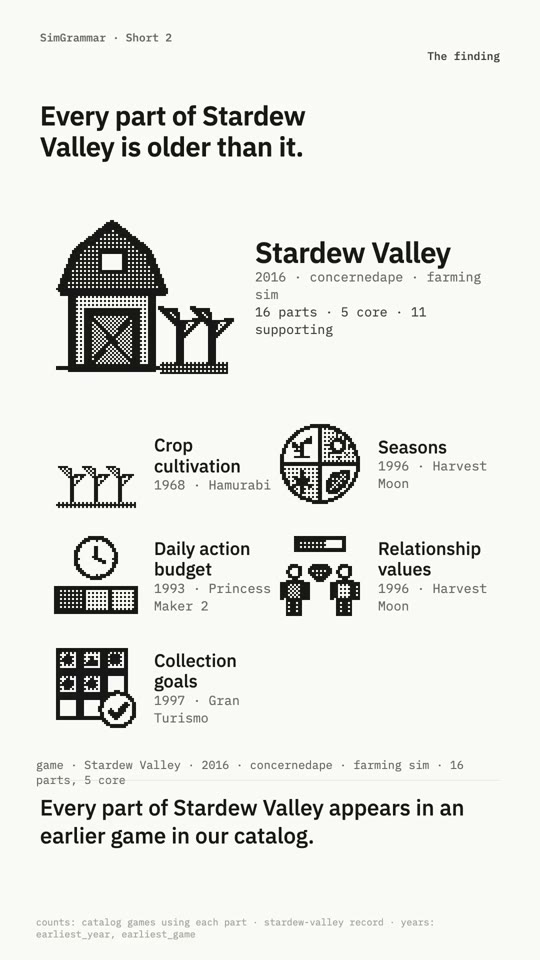 play · 0:40
short 2 0:40
Every part of Stardew Valley is older than it
transcript
Every part of Stardew Valley appears in an earlier game in our catalog.
Crops first appear in Hamurabi, a text game from 1968. A daily action budget first appears in Princess Maker 2, in 1993. Seasons and friendships with villagers first appear in Harvest Moon, in 1996, the game Stardew was built in response to.
That is the norm. Games released since 2010 draw 84 percent of their mechanics from parts that already existed by 2000.
Stardew sets its own numbers: 250 friendship points a heart, and two lost on each day you don't talk to someone.
also on the pages for
 Collection goals
 Seasonal world reset
core loop
clear land and plant seasonal crops -> water daily and tend livestock -> ship produce for money -> buy animals, seeds, and upgrades -> build relationships and attend festivals -> marry and raise a child before the father's evaluation
design notes
Director Yasuhiro Wada started the project with three principles (no fighting, uniqueness, and tactile real-time action), and a team of 8 to 10 people at Pack-In-Soft scaled it back to fit SNES limits. The farm rules are forgiving but daily: unwatered crops stop growing instead of dying, chickens need only feed but can die if left outside, and cows must be fed, talked to, brushed, and milked or they sicken. Play is bounded by a two-and-a-half-year term that ends with the father's evaluation of the farm and family, which makes marriage and a child goals alongside crops and livestock.
appears in
the paper, 2 sections · 2 chapters · 2 episodes · 1 shortWhere the parts came from
on screen at 6:25 parts that waited, 7:04 built from older parts