
smart-objects mechanic sourced
Smart objects
Objects advertise the need satisfaction they offer, and agents query nearby objects to decide what to do.
watch
1 short with this record on screen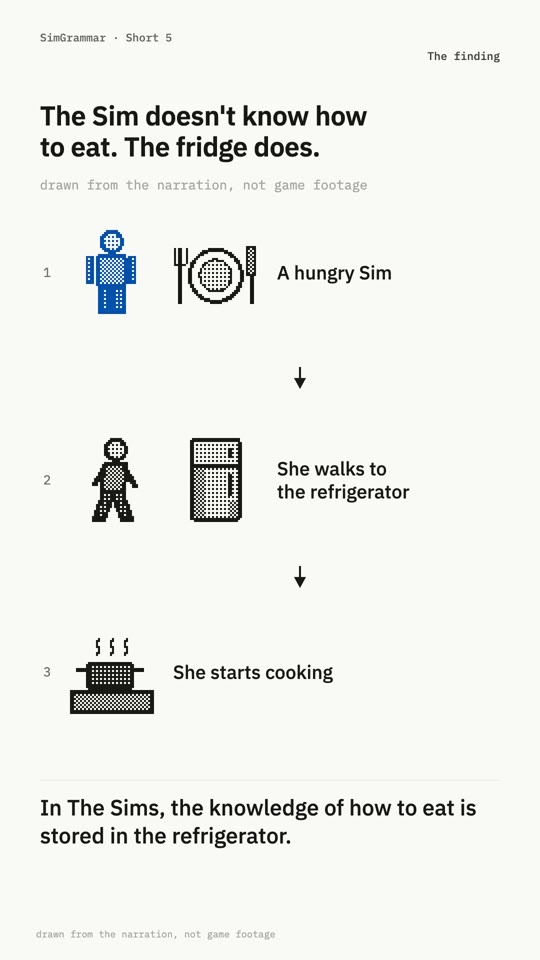 play · 0:36
short 5 0:36
The refrigerator knows
transcript
In The Sims, the knowledge of how to eat is stored in the refrigerator.
Every object advertises what it offers. The refrigerator advertises Hunger, the bed Energy. A Sim weighs the offers in reach against what it needs and picks one, and the object brings the script and the animation [1].
Expansions taught Sims new things largely by selling them new objects.
It also meant every behavior was made by hand. The base game shipped with more than 150 objects, and the dataset scores the method 4 out of 5 for authoring cost.
also on the pages for
 Needs decay
definition
Owns per-object interaction definitions: each interaction carries advertisements (which needs it satisfies and by how much), availability checks, distance attenuation, and the behavior script the agent runs. Agents carry no knowledge of how to use things; when choosing, an agent gathers advertisements from reachable objects, scales them by its needs, personality, and distance, selects one, and runs that object's script. In The Sims, per Forbus and Wright's notes, advertisements cover nine motives, can scale with personality points, attenuate with distance through high, moderate, low, or none presets, and check trees hide unavailable interactions; a toilet advertises 0-70 Bladder. Because behavior lives in objects, new objects add new behaviors without changing agent code, which suits expansion packs and mods. Inputs: objects in range, agent needs. Outputs: candidate actions, need restoration, animations.
player experience
Buying or placing an object changes what agents want to do, so the player designs behavior through the environment. Players learn that a better object pulls agents across the room and use placement to steer them.
design levers
- advertised magnitude per need and whether it scales with personality or object quality
- distance attenuation curve per interaction
- advertised versus delivered value, which allows deceptive or broken objects
- availability and permission checks such as ownership, age, and room
- how many agents one object can serve at once
failure modes
- An over-tuned advertisement makes one object a magnet that agents queue for regardless of need.
- Assuming honest advertisements breaks when objects fail, producing loops of agents repeatedly using broken objects.
- Attenuation errors make agents walk past nearby options to distant ones.
- Behavior spread across hundreds of objects is harder to debug than one agent controller.
dynamics
- Each new object adds behaviors, so the behavior space grows with content packs, which is how The Sims expansions extended play.
- Players use objects as lures to route agents, coupling placement to behavior.
- Scarce objects create queues and conflicts when several agents select the same one.
open questions
- Can generative models author new objects with consistent advertisements, scripts, and animations, turning content packs into runtime generation?
- Should language-model agents read object affordances as numeric advertisements, as text descriptions, or both?
appears in
the paper, 2 sections · 4 chapters · 3 episodes · 1 shortThe five ceilings
on screen at 0:45 behavior that lives in objects, 6:26 lifting one ceiling spends another
 Learned physics-based character control