relationship-values mechanic sourced
Relationship values
Pairwise numeric affinity between characters changes with interactions and drives social choices.
watch
1 short with this record on screen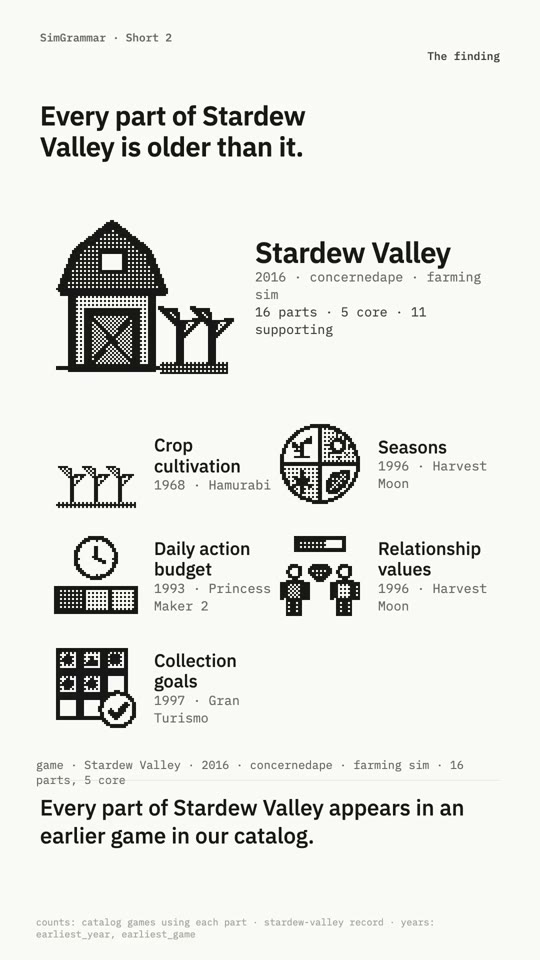 play · 0:40
short 2 0:40
Every part of Stardew Valley is older than it
transcript
Every part of Stardew Valley appears in an earlier game in our catalog.
Crops first appear in Hamurabi, a text game from 1968. A daily action budget first appears in Princess Maker 2, in 1993. Seasons and friendships with villagers first appear in Harvest Moon, in 1996, the game Stardew was built in response to.
That is the norm. Games released since 2010 draw 84 percent of their mechanics from parts that already existed by 2000.
Stardew sets its own numbers: 250 friendship points a heart, and two lost on each day you don't talk to someone.
also on the pages for
 Crop cultivation
 Daily action budget
 Seasons
 Collection goals
 Seasonal world reset
definition
Owns a weighted, often directed graph over agent pairs holding one or more scalar affinities (friendship, romance, respect) and labels derived by threshold (friend, rival, lover). Interactions add or subtract amounts that depend on the action, personalities, and the current value; many games decay values toward neutral without contact. Agents read the values to decide whom to approach, help, or attack. RimWorld opinion runs -100 to 100 with rival below -20 and friend above 20; chitchat adds about 0.66 up to +10, while insults, up to 6 times likelier at -100 opinion, can start social fights. Prom Week keeps three bidirectional networks: buddy, romance, and cool. The Sims: Hot Date introduced separate short-term and long-term relationship scores. Inputs: interactions, traits, events. Outputs: social choices, cooperation, romance eligibility, conflict.
player experience
The player watches friendships and feuds form, reads relationship meters, and engineers meetings to repair or create bonds. Relationships make losses personal and give characters reasons to act together.
design levers
- number of dimensions per pair (single affinity versus friendship, romance, respect)
- change per interaction and its dependence on the current value
- decay toward neutral and its rate
- label thresholds such as friend, rival, and partner
- symmetry: directed or mutual values
failure modes
- One-dimensional affinity conflates liking with respect or attraction, so relationships feel thin.
- Positive feedback drives every long-standing pair to best friends or mortal enemies.
- Repeating one friendly action maxes a relationship with no story behind it.
- Pairwise storage grows with the square of population, so large games restrict it to notable characters.
dynamics
- Agents with compatible traits cluster into friend groups, producing cliques within a colony or town.
- Insults at low opinion push values lower, a reinforcing loop into feuds and fights.
- Deaths and breakups spread grief along the graph, coupling relationships to mood.
open questions
- Can relationship state be inferred from language-model agent conversations rather than incremented by fixed amounts, and stay stable?
- How many relationship dimensions do players track before additional meters stop adding meaning?
appears in
the paper, 2 sections · 3 chapters · 4 episodes · 1 shortrelations
1 stored edges Villager requests
Completing requests raises friendship, giving the social meter a concrete verb (Animal Crossing, Stardew).
 Generative agents (memory stream, reflection, planning)
 Romance and family
 Social exchanges
 Gossip propagation
 Natural-language interaction