decoration-beauty mechanic sourced
Decoration and beauty
Decorative objects and scenery carry beauty values that are aggregated over tiles, rooms, or radii and feed agent mood or ratings.
watch
1 short with this record on screen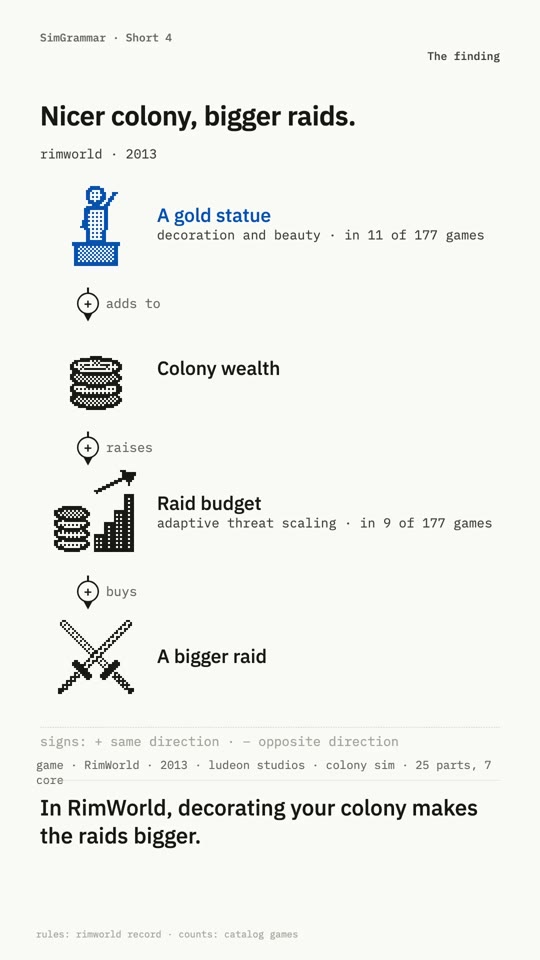 play · 0:36
short 4 0:36
Decorating makes the raids bigger
transcript
In RimWorld, decorating your colony makes the raids bigger.
Before every raid the game adds up your colony's wealth and your colonists and turns the total into a budget for the attackers. Wealth starts adding to that budget above 14,000 and keeps adding up to a million [1].
So experienced players keep their colonies plain. They skip the statues and the fine furniture so the raids stay small.
None of it is on screen. The formula lives on the community wiki, and the dataset scores the mechanic 2 out of 5 for legibility, the level where players understand it only through wikis.
also on the pages for
 Adaptive threat scaling
 Raid defense
definition
Each decorative object, floor, or surface has a beauty value, and dirt, corpses, and filth are negative. The game aggregates values over a radius or a room and samples the result for agents or attractions. In RimWorld a room's beauty is total beauty divided by a weighted size (the size if above 40 tiles, otherwise 20 plus half the size), graded from hideous (below -3.5) to unbelievably beautiful (100 or more), and combined with wealth, space, and cleanliness into impressiveness that sets mood thoughts; colonists also get mood from the beauty around them. In RollerCoaster Tycoon 2, as documented by OpenRCT2, scenery within 5 tiles of a ride's station adds 0.05 excitement per item up to 47 items. The Sims 4 rates rooms by an environment score from decor. Inputs are placed objects; outputs are mood, ratings, or prices.
player experience
Cosmetic choices get a mechanical payoff, so players dress up rooms and paths and watch moods or ride ratings rise. The tension is between beautiful and efficient: every statue costs resources and floor space that production could use.
design levers
- beauty value and cost of each object, and negative values for filth and industry
- aggregation rule: per tile, per radius, per room, with or without size normalization
- caps or diminishing returns on how much decoration counts
- which systems consume beauty: mood, ratings, prices, or visitor choice
- per-agent taste variation by trait or culture
failure modes
- One object with the best beauty per cost dominates, so players spam it regardless of how the space looks.
- Proximity rules that count only a hot spot, such as scenery near a ride station in RollerCoaster Tycoon 2, reward decorating one spot and ignoring the rest of the ride.
- Beauty values that disagree with the art (an ugly-looking object rated beautiful) break trust in the system.
- If the score is hidden, decoration reads as optional and the mechanic goes unused.
dynamics
- Traffic creates filth that lowers beauty, which creates cleaning jobs that compete for labor.
- In RimWorld, decoration raises colony wealth, and wealth raises raid points, so beauty carries a security cost.
- Prosperity funds decoration, and decoration raises mood or ratings and so prosperity, a slow upgrade treadmill.
open questions
- Can a vision model score the composition of a space instead of summing per-object beauty values, and would players accept its judgment?
- Does generated decor reduce the asset cost enough to make beauty a deep system rather than a spam target?
appears in
the paper, 3 sections · 1 chapter · 1 shortrelations
1 stored edges Room recognition
Room quality depends on furnishings and beauty, rewarding interior design.
 3D Gaussian Splatting
 Neural rendering in the graphics pipeline