causal-why-query opportunity asserted
Why-query over the simulation log
Let players ask why something happened and answer from the simulation's own event log, making deep systemic games legible without simplifying them.
watch
2 shorts with this record on screen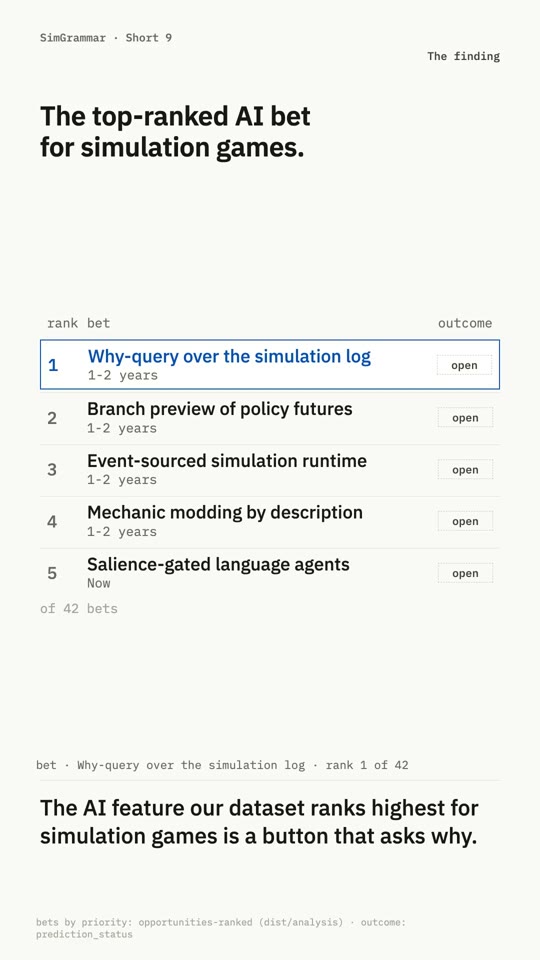 play · 0:39
short 9 0:39
The why button
transcript
The AI feature our dataset ranks highest for simulation games is a button that asks why.
We scored 42 bets on impact, feasibility, and novelty, and this one came first. Right-click the hospital that closed three months ago, ask why, and get a few sentences, each linked to an event in the game's own log. The model can only say what it can point to. If it can't ground an answer, it says so.
The bet has a deadline. If no game with at least ten thousand Steam reviews ships it by December 31, 2027, answering free-text questions from the player's own save, it loses.
also on the pages for
 play · 0:35
short 11 0:35
Due on the same day
transcript
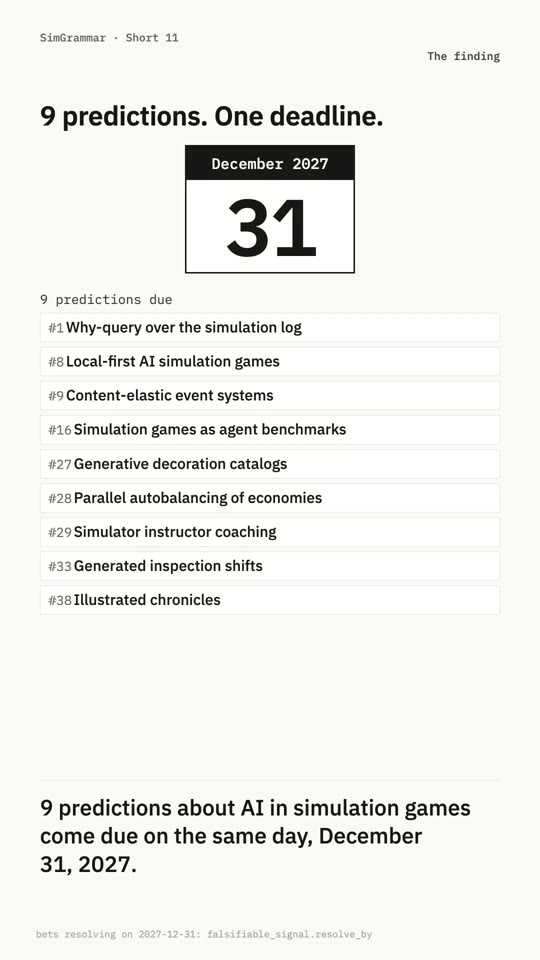
9 predictions about AI in simulation games come due on the same day, December 31, 2027.
Every bet in our dataset carries one, written so a stranger could check it. Take the first: a widely played game lets you ask why something happened in your own save. It only counts if it shipped after October 24, 2026, in a game with ten thousand Steam reviews, answering from your save and not from a manual.
And the person who checks can't be the one who made the bet, or the same AI model that wrote it.
also on the pages for
thesis
The strongest constraint on simulation depth has been legibility: players abandon systems they cannot diagnose, so designers cap coupling. Overlays and causal tooltips help with current values but not with histories ('why did the hospital close?'). If the simulation records an event log with causes, a language model can retrieve the relevant chain and narrate it with citations to specific events, and a constrained output format can force every claim to point at a logged record. This turns the event log, which many engines already keep for replays and debugging, into a player-facing explanation layer.
design sketch
A query box and a right-click 'why?' on any entity. The answer is three to six sentences, each linked to log events the player can jump to on the timeline, plus a small causal graph. Answers that cannot be grounded say so. Advisors use the same pipeline proactively when a key indicator crosses a threshold.
validation experiment
Instrument an open-source simulation (a city or colony sim) to log events with parent-cause ids. Give two player groups the same failing save; one gets the why-query. Measure time to correct diagnosis and the share of answer sentences whose cited events actually support them (human audit). Success: 40 percent faster diagnosis with at least 95 percent supported sentences.
key risks
- Ungrounded but fluent answers teach players wrong models of the system.
- Event logs in shipped engines often lack cause links; instrumenting them is real work.
- Explanations can make optimal play too easy, flattening difficulty.
falsifiable prediction
A widely played simulation or strategy game will let players ask in natural language why something happened in their own game and answer from game state.
Feature first shipped after 2026-10-24 in a title with at least 10,000 Steam user reviews; release notes or the store page describe free-text causal questions answered from the player's own save state, not from a wiki or general help text.
appears in
the paper, 2 sections · 2 chapters · 2 episodes · 2 shortsKeeping score
on screen at 0:00 cold open, 0:24 reading it literally, 1:59 two tests per bet, 5:27 what the scoreboard tests and 1 more