
adaptive-threat-scaling mechanic sourced
Adaptive threat scaling
Threat intensity is computed from a measure of the player's strength, such as wealth, population, time survived, or recent performance.
watch
1 short with this record on screen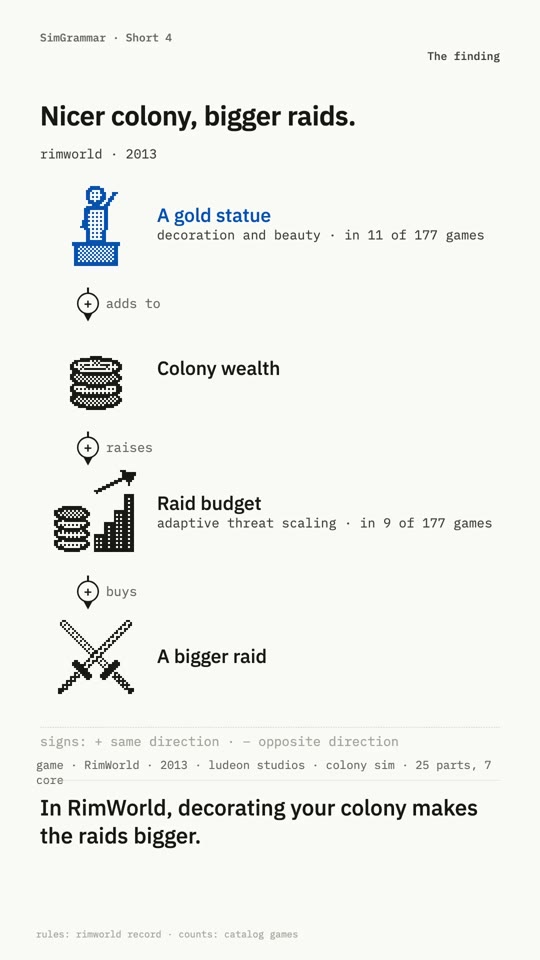 play · 0:36
short 4 0:36
Decorating makes the raids bigger
transcript
In RimWorld, decorating your colony makes the raids bigger.
Before every raid the game adds up your colony's wealth and your colonists and turns the total into a budget for the attackers. Wealth starts adding to that budget above 14,000 and keeps adding up to a million [1].
So experienced players keep their colonies plain. They skip the statues and the fine furniture so the raids stay small.
None of it is on screen. The formula lives on the community wiki, and the dataset scores the mechanic 2 out of 5 for legibility, the level where players understand it only through wikis.
also on the pages for
 Decoration and beauty
definition
The game keeps a threat budget recomputed before each hostile event as a function of one or more proxies for player strength, multiplied by a difficulty scalar, and spends that budget on enemy count and composition. RimWorld computes raid points as (wealth points + pawn points) x threat scale x starting factor x adaptation factor, capped at 10,000: wealth points rise from 0 at 14,000 storyteller wealth to 4,200 at 1,000,000, each healthy colonist adds 15 to 200 points, a 0.7 starting factor applies through day 10, and an adaptation factor drops after colonist deaths or downings. Factorio's enemy evolution factor rises with elapsed time, pollution produced, and spawners destroyed, unlocking larger biters. Oblivion scaled enemy level to the player's level. Inputs: player state proxies and recent losses. Output: a scalar budget or tier consumed by the event or spawn system.
player experience
Success is answered by stronger opposition, so the player never fully escapes danger. Players learn to read what the game counts as strength and manage it: converting wealth into combat power instead of decoration, or holding back expansion. After a disaster, mercy terms give a breathing window that feels like the world easing off.
design levers
- which proxies define strength (wealth, population, time, kills, player level, recent damage taken)
- the curve from proxy to budget, including dead zones, piecewise slopes, and the hard cap
- difficulty multiplier presets and whether players can set them freely
- adaptation or mercy terms that lower the budget after losses and raise it after easy wins
- grace period length before scaling starts
- how budget maps to enemy composition, such as tiers unlocked at thresholds versus more of the same unit
failure modes
- Scaling on wealth punishes building: RimWorld players practice wealth management, avoiding valuable furniture or art so raids stay small.
- Scaling on player level makes progression feel null when every enemy keeps pace, a common criticism of The Elder Scrolls IV: Oblivion.
- Proxies that ignore defensive investment let a cheap killbox beat budgets tuned for open combat, or let an undefended rich colony be overwhelmed.
- Opaque formulas read as the game cheating when a large attack follows a burst of growth.
dynamics
- Players optimize the ratio of combat value to counted value, producing lean, militarized bases.
- Run length and difficulty converge across skill levels because the system rubber-bands toward a target challenge.
- Coupled with permadeath, the adaptation term creates recovery arcs after a massacre instead of an immediate death spiral.
- Coupled with pollution or expansion (Factorio), the threat becomes a cost of growth that players trade against output.
open questions
- Can a learned estimate of actual defensive capability, such as a fast simulated raid against the current base, replace wealth proxies and remove the incentive to stay poor?
- What adaptation rate keeps tension stable without players perceiving rubber-banding?
appears in
the paper, 2 sections · 4 episodes · 1 shortEvery simulation game is made of the same parts
on screen at 0:32 rimworld, in parts, 1:38 rare parts, 3:43 six jobs
Families across genres
on screen at 0:17 cold open, 0:27 same chain, different games, 4:07 odd couples, 5:12 series and descendants and 1 more
relations
3 stored edges Raid defense
Raids grow with the colony, so defenses must scale.
 Storyteller director
The director spends a threat budget that scales with wealth, keeping pressure proportional to success.
 Milestone unlocks
One rewards growth, the other punishes it; tuning both sets the game's attitude to expansion.
 Agent-based automated playtesting and balancing
 Learned level and map generation (PCGRL, MarioGPT, LLM generators)
 Open-ended co-generation of environments and agents
 Simulation-based inference for calibrating simulators