generated-inspection-shifts opportunity asserted
Generated inspection shifts
Rule-checking job sims with generated documents, items, and rule changes each shift, verified against an answer key so infinite variety stays fair.
watch
2 shorts with this record on screen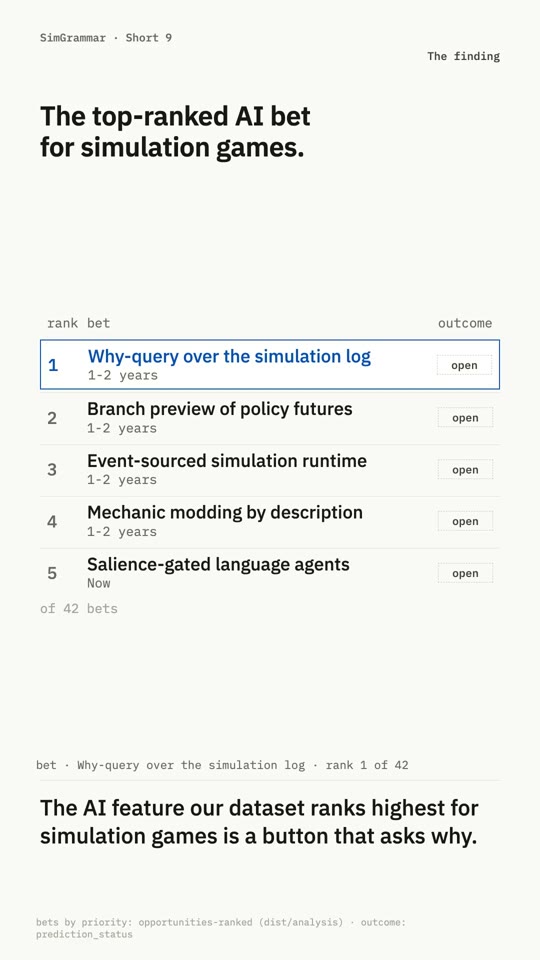 play · 0:39
short 9 0:39
The why button
transcript
The AI feature our dataset ranks highest for simulation games is a button that asks why.
We scored 42 bets on impact, feasibility, and novelty, and this one came first. Right-click the hospital that closed three months ago, ask why, and get a few sentences, each linked to an event in the game's own log. The model can only say what it can point to. If it can't ground an answer, it says so.
The bet has a deadline. If no game with at least ten thousand Steam reviews ships it by December 31, 2027, answering free-text questions from the player's own save, it loses.
also on the pages for
 play · 0:35
short 11 0:35
Due on the same day
transcript
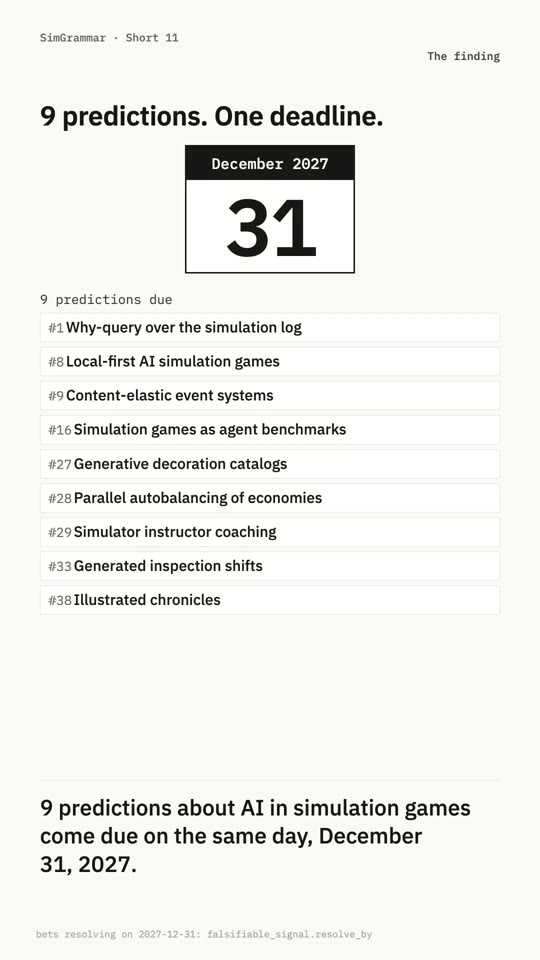
9 predictions about AI in simulation games come due on the same day, December 31, 2027.
Every bet in our dataset carries one, written so a stranger could check it. Take the first: a widely played game lets you ask why something happened in your own save. It only counts if it shipped after October 24, 2026, in a game with ten thousand Steam reviews, answering from your save and not from a manual.
And the person who checks can't be the one who made the bet, or the same AI model that wrote it.
also on the pages for
thesis
Papers, Please and its successors are limited by hand-built document sets that players memorize. Constrained generation can produce documents, forgeries, and edge cases from a formal rule set, and because the rules are formal, every generated case has a computable correct answer. That combination gives endless fair variety, which ordinary procedural generation struggles to make interesting and unconstrained generation cannot make fair.
design sketch
Each day introduces rule changes written as formal predicates and rendered as in-world memos. Applicants, documents, and stories are generated to exercise boundary cases of the current rules. The game knows the correct ruling for every case and scores accordingly.
validation experiment
Generate 1,000 inspection cases from a 30-predicate rule set and have a checker and two humans verify the answer key on a sample of 200. Success: 99 percent agreement between generated answers and human rulings.
key risks
- Generated text leaks the answer or contradicts the formal case.
- Repetitive tone across generated applicants.
falsifiable prediction
An inspection or bureaucracy job sim will generate documents or applicants at runtime and score the player against an answer key derived from formal rules.
Released after 2026-10-24 with at least 1,000 Steam user reviews; store page or developer statement describes runtime-generated cases whose correct outcome is computed from the game's rules, not authored per case.