local-first-ai-sims opportunity asserted
Local-first AI simulation games
Ship small language and generative models inside the game so AI features run offline with no per-hour inference bill, changing the economics of AI-native simulation.
watch
2 shorts with this record on screen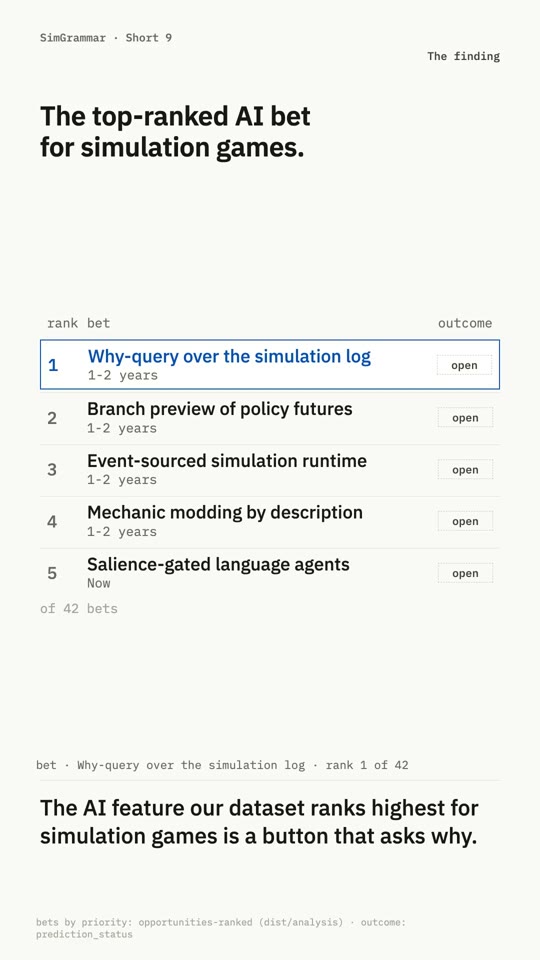 play · 0:39
short 9 0:39
The why button
transcript
The AI feature our dataset ranks highest for simulation games is a button that asks why.
We scored 42 bets on impact, feasibility, and novelty, and this one came first. Right-click the hospital that closed three months ago, ask why, and get a few sentences, each linked to an event in the game's own log. The model can only say what it can point to. If it can't ground an answer, it says so.
The bet has a deadline. If no game with at least ten thousand Steam reviews ships it by December 31, 2027, answering free-text questions from the player's own save, it loses.
also on the pages for
 play · 0:35
short 11 0:35
Due on the same day
transcript
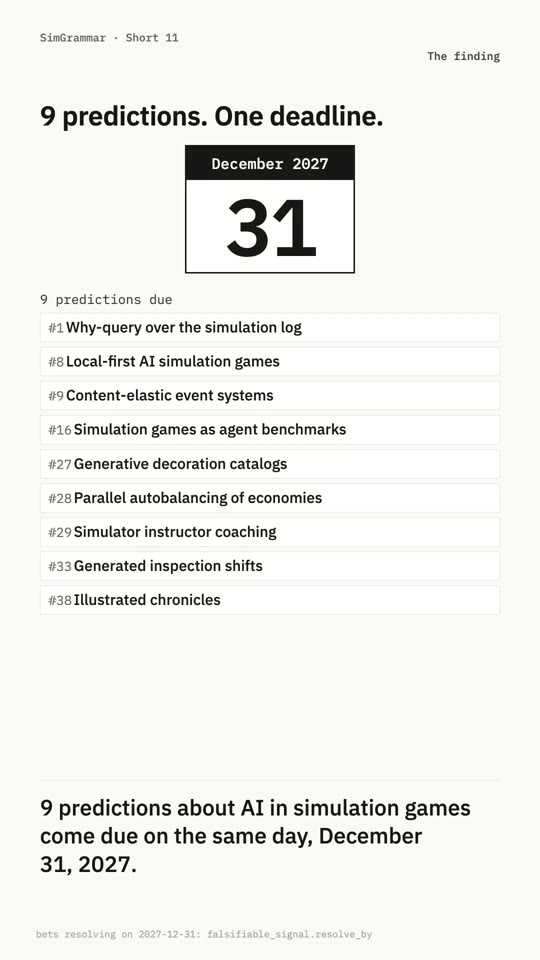
9 predictions about AI in simulation games come due on the same day, December 31, 2027.
Every bet in our dataset carries one, written so a stranger could check it. Take the first: a widely played game lets you ask why something happened in your own save. It only counts if it shipped after October 24, 2026, in a game with ten thousand Steam reviews, answering from your save and not from a manual.
And the person who checks can't be the one who made the bet, or the same AI model that wrote it.
also on the pages for
thesis
Cloud inference makes AI features a variable cost per player-hour, which conflicts with the one-time-purchase model of most simulation games and their very long play sessions. Small models running on consumer GPUs and NPUs reached usable quality for constrained tasks in 2025 (inZOI's on-device characters are an example). Local-first design bounds cost, works offline, protects privacy, and survives the vendor's model deprecations.
design sketch
The game ships a quantized model for dialogue, event generation, and explanation, with a schema-constrained interface. Higher-quality cloud calls are optional and clearly metered. Mods can swap models.
validation experiment
Benchmark a 1 to 4 billion parameter quantized model on the median Steam hardware survey GPU for schema-constrained NPC dialogue, measuring latency, VRAM, and frame-time impact. Success: under 500 ms first token with less than 10 percent frame-time impact.
key risks
- Hardware minimums shrink the audience.
- Model quality gap versus cloud models.
- Download size and VRAM competition with rendering.
falsifiable prediction
At least five games with over 1,000 Steam user reviews will use an on-device language model at runtime without requiring an internet connection.
Count titles whose local-model feature first shipped after 2026-10-24; store pages or documentation confirm local inference for runtime features, and each title has more than 1,000 Steam user reviews by the resolve date.