content-elastic-events opportunity asserted
Content-elastic event systems
Remove the authoring ceiling on event chains, requests, and dilemmas by generating schema-constrained variants from designer templates and validating them against game state.
watch
2 shorts with this record on screen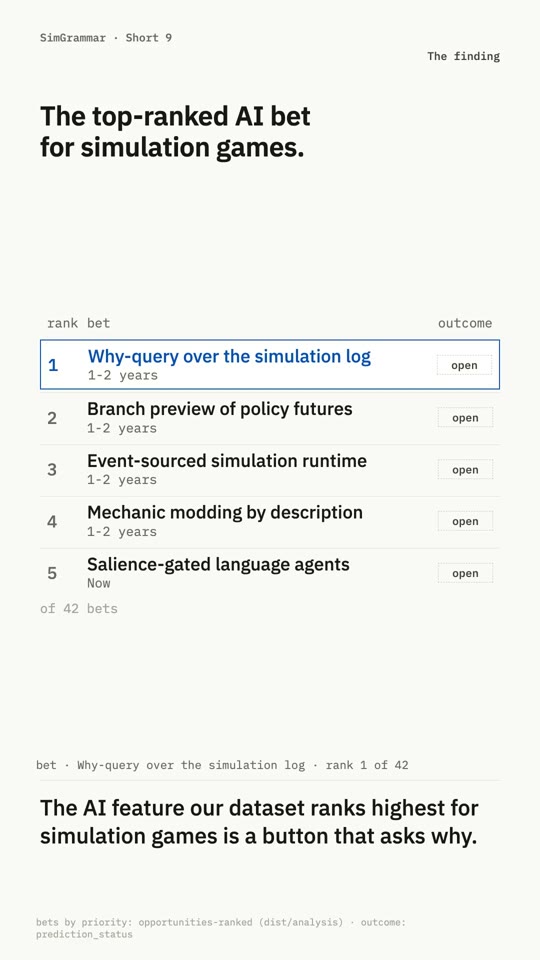 play · 0:39
short 9 0:39
The why button
transcript
The AI feature our dataset ranks highest for simulation games is a button that asks why.
We scored 42 bets on impact, feasibility, and novelty, and this one came first. Right-click the hospital that closed three months ago, ask why, and get a few sentences, each linked to an event in the game's own log. The model can only say what it can point to. If it can't ground an answer, it says so.
The bet has a deadline. If no game with at least ten thousand Steam reviews ships it by December 31, 2027, answering free-text questions from the player's own save, it loses.
also on the pages for
 play · 0:35
short 11 0:35
Due on the same day
transcript
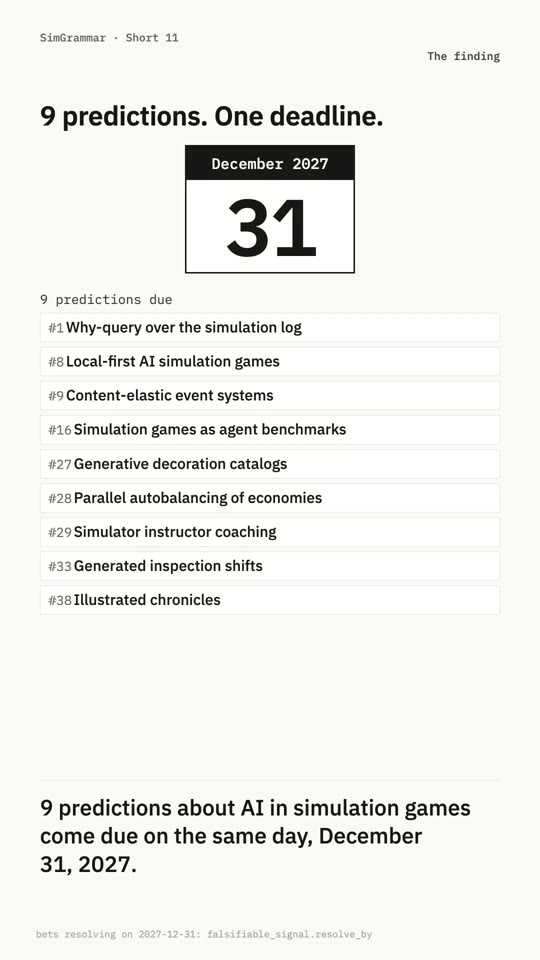
9 predictions about AI in simulation games come due on the same day, December 31, 2027.
Every bet in our dataset carries one, written so a stranger could check it. Take the first: a widely played game lets you ask why something happened in your own save. It only counts if it shipped after October 24, 2026, in a game with ten thousand Steam reviews, answering from your save and not from a manual.
And the person who checks can't be the one who made the bet, or the same AI model that wrote it.
also on the pages for
thesis
Event chains, villager requests, and dilemma cards are capped by writing budgets: players exhaust the deck and recognize repeats. Language models can generate variants, but unconstrained text breaks game logic. Templates with typed slots, constrained decoding into the event schema, and automated checks against preconditions let a small team ship a deck that keeps producing valid, state-aware events.
design sketch
Designers write 200 event templates with preconditions, effects, and tone notes. At build time or runtime, a generator instantiates variants that reference specific characters, places, and history from the save, emits schema-valid events, and passes them through a validator that rejects anything whose effects violate invariants. Generated events are tagged so players can filter them.
validation experiment
Take 50 authored events from an existing design, generate 500 variants, have blind raters compare authored and generated events on quality, and run a validator on every variant. Success: generated events rated within 0.5 points of authored ones with 99 percent passing validation.
key risks
- Generated text quality below authored text lowers perceived quality.
- Disclosure and player backlash against AI-generated writing.
- Validation catches logic errors but not tone errors.
falsifiable prediction
A grand strategy, life sim, or narrative management game will ship runtime-generated events constrained by an event schema.
Feature first shipped after 2026-10-24 in a title with at least 1,000 Steam user reviews; the Steam AI disclosure or developer documentation states that events are generated during play and must conform to a fixed structure of triggers, options, and effects.