
seasons mechanic sourced
Seasons
A seasonal calendar cycles conditions such as temperature, daylight, and growing windows that govern growth, demand, and risk.
watch
1 short with this record on screen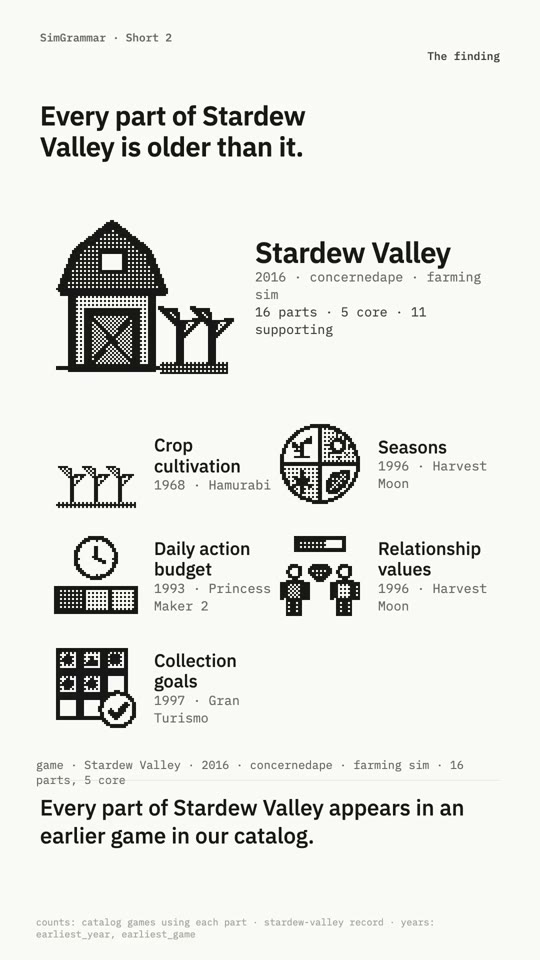 play · 0:40
short 2 0:40
Every part of Stardew Valley is older than it
transcript
Every part of Stardew Valley appears in an earlier game in our catalog.
Crops first appear in Hamurabi, a text game from 1968. A daily action budget first appears in Princess Maker 2, in 1993. Seasons and friendships with villagers first appear in Harvest Moon, in 1996, the game Stardew was built in response to.
That is the norm. Games released since 2010 draw 84 percent of their mechanics from parts that already existed by 2000.
Stardew sets its own numbers: 250 friendship points a heart, and two lost on each day you don't talk to someone.
also on the pages for
 Relationship values
 Crop cultivation
 Daily action budget
 Collection goals
 Seasonal world reset
definition
Owns a calendar position that advances by day and maps to a season index, usually four. Each season sets parameters other systems read: which crops can grow, temperature, day length, weather odds, animal behavior, demand for heat or food, and scheduled events. Stardew Valley has four 28-day seasons, and seasonal crops must generally be harvested before the next season arrives; Don't Starve's base cycle alternates 20 summer days and 16 winter days and changes the day, dusk, and night split with them; Banished and Farthest Frontier force food stockpiling for winters without harvests. Inputs are elapsed days; outputs are season flags and parameter sets. Some games make season length a setting.
player experience
Planning in cycles. The player plants for this season while saving for the next, treats the end of a season as a deadline, and gets a fresh start each spring. Winter tests the year's preparation, and the cycle gives long games a felt rhythm.
design levers
- number and length of seasons, and whether lengths vary or can be set
- which systems each season modifies: growth, temperature, weather, events, prices
- severity of the harshest season and how much stockpiling it demands
- transition rules, such as crops dying at the change or gradual change
- season-unique content: crops, festivals, creatures
failure modes
- Seasons that only swap textures add art cost without changing decisions.
- A harsh season survivable only with one known stockpile size becomes a checklist.
- Season-gated content locks players out for long stretches when they miss a window.
dynamics
- Seasonal production with year-round consumption creates demand for storage, preservation, and trade.
- Combined with a crisis countdown, the approach of winter structures the year as preparation.
- Labor shifts between seasonal tasks, creating idle periods and peaks.
open questions
- Can generative asset models make seasonal variants of every asset cheap enough that seasons become a default rather than a budget decision?
 Crisis countdown