
collection-goals mechanic sourced
Collection goals
Catalogs of items, species, or bundles give the player sets to complete for rewards or recognition.
watch
1 short with this record on screen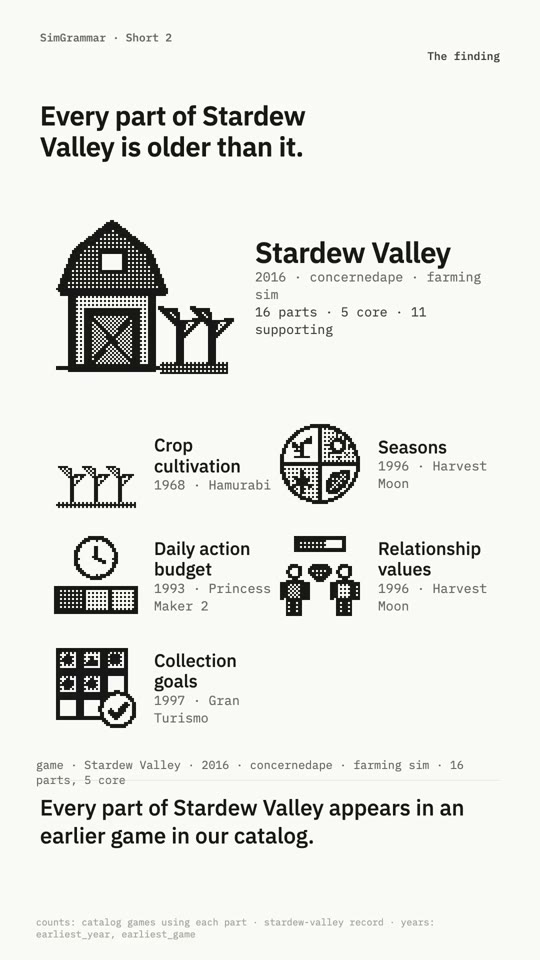 play · 0:40
short 2 0:40
Every part of Stardew Valley is older than it
transcript
Every part of Stardew Valley appears in an earlier game in our catalog.
Crops first appear in Hamurabi, a text game from 1968. A daily action budget first appears in Princess Maker 2, in 1993. Seasons and friendships with villagers first appear in Harvest Moon, in 1996, the game Stardew was built in response to.
That is the norm. Games released since 2010 draw 84 percent of their mechanics from parts that already existed by 2000.
Stardew sets its own numbers: 250 friendship points a heart, and two lost on each day you don't talk to someone.
also on the pages for
 Relationship values
 Crop cultivation
 Daily action budget
 Seasons
 Seasonal world reset
definition
The game defines named sets of collectibles (items, fish, insects, fossils, species, recipes) and tracks which members the player has obtained, donated, or observed. State owned: per set, a membership checklist and completion state. Update rule: when the player acquires or submits a qualifying item, mark it; when a set is complete, grant a reward or unlock. Collection drives engagement with other systems because members are spread across seasons, locations, and rarities. Canonical forms: Stardew Valley's Community Center, with six rooms and thirty bundles whose rewards repair the quarry bridge, greenhouse, minecarts, and bus, Animal Crossing: New Horizons' museum and Critterpedia, and Viva Pinata's species journal with per-species visit, resident, and romance requirements.
player experience
A gentle, open checklist. The player plans around a missing fish that appears only in rain in autumn, feels a click when a set completes, and has a reason to explore every corner of the simulation.
design levers
- set size and rarity distribution of members
- seasonal, weather, or location gating of members
- reward type: functional unlocks, cosmetics, or none
- fixed versus randomized set contents, such as Stardew Valley remixed bundles
- whether items are consumed by submission
- visibility of missing members as silhouettes or hints
failure modes
- The last few rare members take far longer than the rest, turning completion into a grind.
- Members missable for a season or year punish players who fall behind.
- Functional rewards locked behind collection force players who dislike collecting through it.
dynamics
- Collection targets route player attention through seasons, weather, and locations they would otherwise skip.
- Players share calendars and spreadsheets of where and when members appear.
- Alternative completion routes, such as the Joja membership in Stardew Valley, frame collection as a moral choice.
open questions
- Can generated collectible sets tied to world state, such as species that evolved in this run, keep collection goals meaningful in procedural worlds?
- What rarity curve keeps the final members exciting rather than grinding?
appears in
the paper, 2 sections · 1 chapter · 2 episodes · 1 shortbacklinks
computed from other records LLM-adjudicated state transitions (LLM as game mechanic)
claims
1 with sourcesStardew Valley's Community Center has six rooms and thirty bundles; completing rooms repairs the quarry bridge, greenhouse, minecarts, and bus, and a Joja membership replaces bundles with payments.