hamurabi game sourced
Hamurabi
A ten-turn text game in which the player, as the Babylonian king Hammurabi, splits a grain stock between feeding people, planting acres, and buying land while harvests, rats, and plague vary at random.
parts
6 mechanics, as Hamurabi does themcore · 3
Crop cultivation
Planted acres consume seed grain and return a random yield per acre at year end; each person can farm only a set amount of land, so labor caps planting.

Goods consumption
People must be fed grain each year; if at least 45 percent starve in one round the game ends early.

Turn structure
Ten rounds, each one year: a status report, then three typed decisions (acres to buy or sell, bushels to feed, acres to plant) before the year resolves.
supporting · 3

Advisors
Each round opens with a steward's report of births, deaths, harvest, rat losses, and land price.

Random disasters
Each year carries a chance of plague that halves the population.

Spoilage
Rats eat a random amount of stored grain each year, a loss on holding stock.
watch
1 short with this record on screen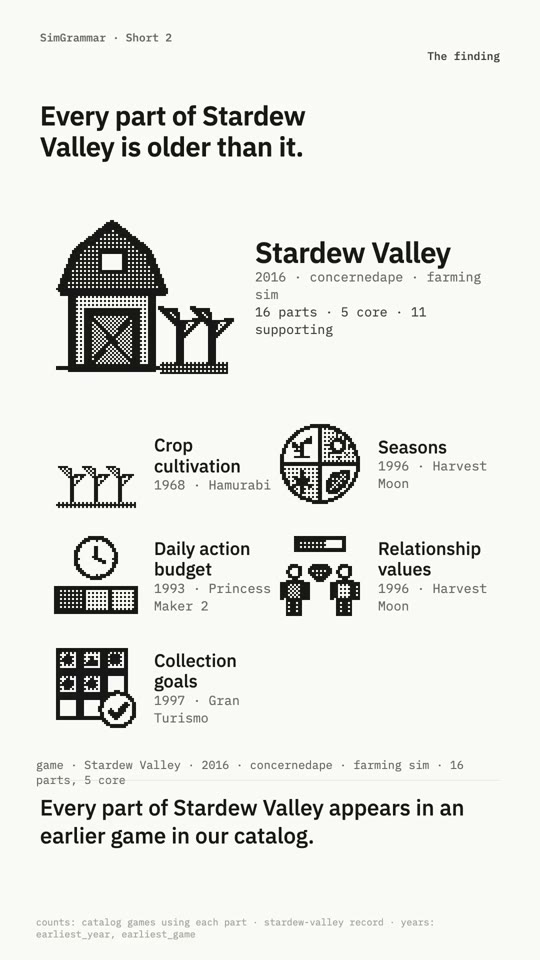 play · 0:40
short 2 0:40
Every part of Stardew Valley is older than it
transcript
Every part of Stardew Valley appears in an earlier game in our catalog.
Crops first appear in Hamurabi, a text game from 1968. A daily action budget first appears in Princess Maker 2, in 1993. Seasons and friendships with villagers first appear in Harvest Moon, in 1996, the game Stardew was built in response to.
That is the norm. Games released since 2010 draw 84 percent of their mechanics from parts that already existed by 2000.
Stardew sets its own numbers: 250 friendship points a heart, and two lost on each day you don't talk to someone.
also on the pages for
 Relationship values
 Daily action budget
 Seasons
 Collection goals
 Seasonal world reset
core loop
read the steward's yearly report -> trade grain for land at a random price -> allocate grain to food and seed -> harvest, rats, arrivals, and plague resolve -> next year
design notes
Three stocks (people, acres, bushels of grain) and three yearly allocations make the whole game one stock-and-flow puzzle: grain is food, seed, and the currency for land at once, so every bushel has competing uses. Randomness enters only through harvest yield, rat losses, a land price of 17 to 26 bushels per acre, arrivals, and a plague that halves the population, so the player manages expected value under variance. Dyment wrote it in FOCAL for the PDP-8 from a description of The Sumerian Game (1964); David Ahl's BASIC version spread it as a type-in listing and seeded Kingdom, Dukedom, and Santa Paravia en Fiumaccio.
appears in
the paper, 4 sections · 3 chapters · 3 episodes · 1 shortWhere the parts came from
on screen at 0:26 hamurabi in parts, 0:45 a date is a lower bound, 6:24 parts that waited
claims
1 with sourcesHamurabi derives from The Sumerian Game (1964) by Mabel Addis and William McKay; Dyment wrote the FOCAL version after learning of it, and David Ahl expanded it in BASIC.