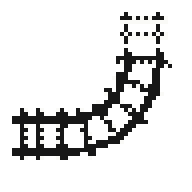
track-laying mechanic asserted
Track laying
The player builds rail or coaster track segment by segment under grade, curvature, terrain, and cost constraints, and vehicles then run on the resulting path.
definition
Owns a set of track pieces joined end to end, each with a type (straight, curve, slope, switch, bridge, tunnel, or special element such as a loop), an entry and exit position and heading, and a cost. Construction extends an open endpoint with a piece whose entry matches it; the game checks grade and curvature limits, terrain clearance, and collisions with other structures, then charges a cost that depends on terrain (slopes, water, demolition) and piece type. Railroad Tycoon and Transport Tycoon lay track on a tile grid, with slopes, bridges, and tunnels in Transport Tycoon; RollerCoaster Tycoon builds coasters piece by piece on a tile grid by direction, height, steepness, and elements such as loops and corkscrews; Planet Coaster adds spline editing; Factorio places straight and curved rail pieces. Outputs: a track graph that vehicles traverse, used by scheduling, signaling, and ride rating. Unlike free-placement, the unit of building is a connected chain rather than a footprint; unlike road-network, it owns segment geometry and its constraints rather than building connectivity; unlike modular-assembly, the result is a path.
player experience
Drawing a line through the world under constraints. Players hunt for the gentle grade around a hill, decide whether a bridge is worth its price, and fit a coaster's drops and turns into a cramped park. A clean line that vehicles run smoothly on is a craft object players admire and share.
design levers
- grade and curve radius limits and their effect on vehicle speed
- terrain cost model for slopes, water, tunnels, and demolition
- piece set: fixed tiles, free splines, or both
- auto-routing tools that pick a path between endpoints
- special pieces such as switches, loops, lifts, and brakes
failure modes
- Tile-locked pieces make every layout look the same; free splines without snapping make clean joins hard.
- Construction controls that need many precise clicks per segment make building tedious.
- Costs too low make terrain irrelevant, so lines ignore the landscape.
dynamics
- Terrain shapes networks and rides: lines follow valleys, and coasters use hills for drops.
- Junction and switch layouts couple track design to signaling and throughput.
- Track geometry feeds ride ratings and train speeds, so building quality shows up in revenue.
open questions
- Can route-finding assistants that propose track under grade and cost constraints keep the craft while removing click work?
- Could generative models propose coaster layouts that hit target ratings for players to refine?