
neural-rendering-shaders technique sourced
Neural rendering in the graphics pipeline
Small neural networks inside the renderer upscale frames, generate extra frames, denoise ray tracing, decode compressed textures and layered materials, and since DLSS 5 re-light the final frame, all without touching simulation state.
watch
1 short with this record on screen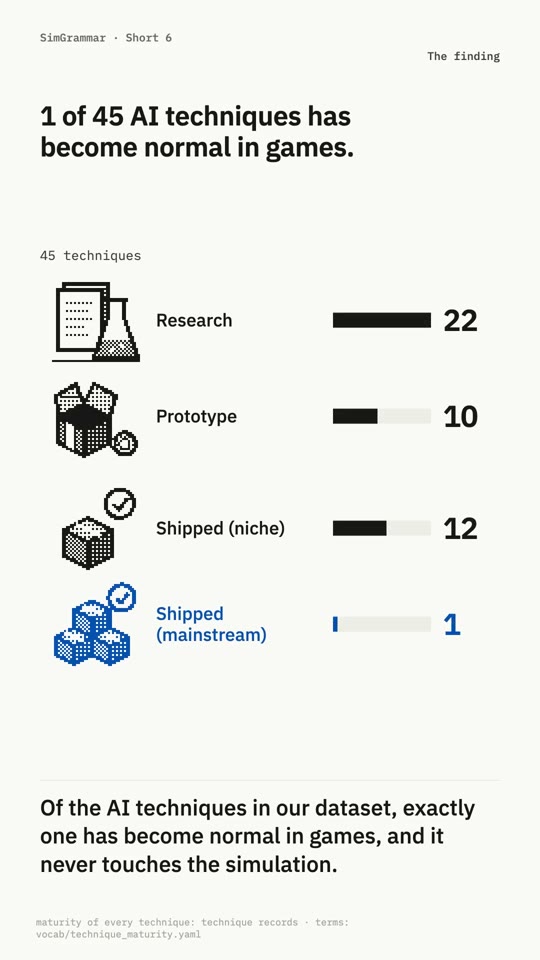 play · 0:40
short 6 0:40
The one AI technique that's normal
transcript
Of the AI techniques in our dataset, exactly one has become normal in games, and it never touches the simulation.
It's neural rendering: upscaling, and frames predicted between the ones the game drew. More than 250 titles support multi-frame generation, and Flight Simulator has frame generation too [1] [2].
A generated frame sits between two real ones, and the simulation never knows. Saves, replays, and multiplayer stay exactly as they were.
The models that would replace the game world itself are still prototypes. Google's Project Genie, built on Genie 3, caps each world at sixty seconds to save compute [3].
also on the pages for
 Genie foundation world models
mechanism
DLSS Super Resolution reconstructs a high-resolution frame from a lower-resolution render plus motion vectors with a transformer network (from DLSS 4); Multi Frame Generation predicts up to three (DLSS 4) or five (DLSS 4.5) frames between rendered frames; Ray Reconstruction replaces hand-tuned denoisers. Neural shaders embed small MLPs inside shader code and run them on tensor units: neural texture compression decodes textures from learned latents, neural materials evaluate layered BRDFs, and the neural radiance cache learns multi-bounce indirect light online. DirectX cooperative vectors expose this to cross-vendor shaders. DLSS 5 adds a final network pass that adds lighting and material detail from color and motion vectors, with developer intensity controls and masks.
limitations
- Changes presentation, not simulation: CPU-bound simulation games (agent counts, pathfinding, economy ticks) gain nothing from GPU-side neural rendering.
- Frame generation adds input latency and artifacts; DLSS 5's final pass reportedly costs 50 to 60 percent of frame rate and can alter art direction.
- Hardware-gated: Multi Frame Generation and DLSS 5 require RTX 50-series GPUs at launch, and neural shader features depend on vendor SDKs and cooperative vector support.
appears in
the paper, 4 sections · 1 chapter · 3 episodes · 1 shortWhat AI shipped
on screen at 1:41 the one that's normal, 5:41 what writes into the simulation, 7:52 close
relations
5 stored edges Day-night cycle
Neural denoising and the neural radiance cache make dynamic multi-bounce lighting affordable, so player-built interiors and towns can be lit correctly across a full diurnal cycle where baked lighting cannot follow player construction.
 Decoration and beauty
Up to 7x VRAM savings from neural texture compression and cheaper layered materials let more distinct high-detail decor assets be resident at once, raising the variety a beauty-driven builder can show on screen.
 Embodied skill control
Upscaling and frame generation raise displayed frame rates in GPU-heavy flight and driving sims for the same render cost; generated frames do not sample new input, so frame generation adds latency that hurts precise hand-flying or driving.
backlinks
computed from other recordsclaims
6 with sourcesDLSS 4 (January 2025) introduced Multi Frame Generation of up to three extra frames per rendered frame on RTX 50 GPUs and transformer models for super resolution and ray reconstruction, with 75 games and apps at launch and up to 8x frame rate over brute-force rendering.
RTX neural shaders (January 2025) included neural texture compression using up to 7x less VRAM than block-compressed textures at equal quality, neural materials up to 5x faster, and a neural radiance cache for multi-bounce indirect lighting, with DirectX cooperative vector support announced.
By January 2026 over 250 titles supported Multi Frame Generation and over 400 games and apps supported DLSS Super Resolution; DLSS 4.5 added a 6X mode generating up to five frames per rendered frame.
DLSS 5 launched on 2026-09-03 in NBA 2K27 as a deterministic one-frame-in, one-frame-out neural pass that adds lighting and material detail, with structure and tone intensity controls and semantic masks for developers.
DLSS 5's reveal drew largely negative reaction from players and developers over altered faces and art direction, and a reported 50 to 60 percent frame-rate cost; frame generation in general adds input latency and can introduce artifacts.
Simulation titles use DLSS: Microsoft Flight Simulator (2020) supports DLSS upscaling and DLSS Frame Generation, and Cities: Skylines II supports DLSS upscaling.
src-pcgamingwiki-2026-msfs-2020, src-pcgamingwiki-2026-cities-skylines-2