
genie-world-models technique sourced
Genie foundation world models
Google DeepMind's Genie models generate playable worlds from a text or image prompt and render them in real time from player input, with Genie 3 reaching 720p at 24 fps and about a minute of visual memory.
watch
1 short with this record on screen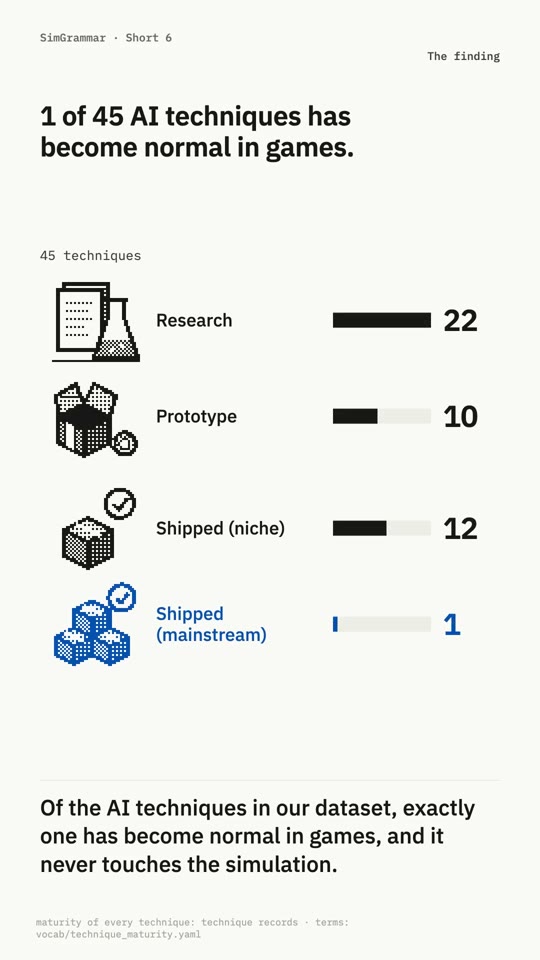 play · 0:40
short 6 0:40
The one AI technique that's normal
transcript
Of the AI techniques in our dataset, exactly one has become normal in games, and it never touches the simulation.
It's neural rendering: upscaling, and frames predicted between the ones the game drew. More than 250 titles support multi-frame generation, and Flight Simulator has frame generation too [1] [2].
A generated frame sits between two real ones, and the simulation never knows. Saves, replays, and multiplayer stay exactly as they were.
The models that would replace the game world itself are still prototypes. Google's Project Genie, built on Genie 3, caps each world at sixty seconds to save compute [3].
also on the pages for
 Neural rendering in the graphics pipeline
mechanism
Genie (2024) learned from 30k hours of unlabeled 2D platformer video: a video tokenizer, a latent action model that infers 8 discrete actions between frames without labels, and a 10.1B-parameter dynamics model that predicts the next frame tokens given an action. Genie 2 (December 2024) is an autoregressive latent diffusion model with a transformer dynamics model that turns a single image into a 3D world controlled by keyboard and mouse. Genie 3 (August 2025) generates frames auto-regressively in real time from a text prompt, keeps visual memory of earlier frames for about a minute so revisited places look the same, and accepts text 'promptable world events' during play that add objects, characters, or weather changes. No explicit 3D scene or game state is stored; consistency comes from the frame history.
limitations
- Session length: Genie 2 coherence is usually 10 to 20 seconds; Genie 3 manages a few minutes; Project Genie caps exploration at 60 seconds because of compute.
- No inspectable state: there are no variables for inventory, health, or object identity, so mechanics that need stocks or rules must live in a separate system.
- Limited action space and no reliable multi-agent interaction (DeepMind's stated Genie 3 limitations).
- Access is a hosted research prototype for paying subscribers; no public API, price per hour, or on-device version is published.
- Guardrails refuse copyrighted settings and nudity, which constrains user-generated worlds.
appears in
the paper, 4 sections · 3 chapters · 3 episodes · 1 shortWhere AI lands
on screen at 1:08 where the techniques come from, 3:56 the most exposed mechanics, 5:07 what they'd change
relations
7 stored edges Direct avatar control
First- or third-person character movement is rendered by the model from WASD, camera, and jump input; the action space is small and collisions are not guaranteed (characters passing through walls).
 Generative content on demand
Whole explorable scenes, characters, and events are generated at runtime from player text, sketches, or photos, which extends generative content from text and items to playable space.
 God powers
Promptable world events work as a free-form god power: typed text adds characters, objects, or weather to the running world; Genie 3 attaches no cost or rule to them and their effects exist only in rendered frames.
 Procedural terrain
Worlds come from a text or image prompt instead of a seed and noise pipeline, in any visual style; persistence is minutes long (about one minute of visual memory in Genie 3, 60-second sessions in Project Genie).
 Rigid-body physics
Object responses such as doors opening, balloons bursting, water, and smoke are produced by learned video dynamics (Genie 2) rather than a physics engine, with no conservation or collision guarantees.
 Storyteller director
A director could inject an event (a new character, object, or condition) as a text prompt that Genie 3 renders into the running world, removing per-event art and animation; event selection and pacing still need a separate system with real state.
 Weather
Genie 3's promptable world events change weather by text during a session with no weather simulation or authored weather assets; the change is visual only and has no stored state for crops, agents, or travel to read.
backlinks
computed from other records Open-ended co-generation of environments and agents
claims
6 with sourcesGenie has 11B parameters trained on 30k hours of 2D platformer clips with 8 latent actions; it generates about 1 frame per second and has 16 frames of memory, which the paper lists as limitations.
Genie 2 turns one image into a playable 3D world with water, smoke, gravity, lighting, door opening, and NPCs; worlds stay coherent for up to a minute, but most examples last 10 to 20 seconds.
Genie 3 renders 720p at 24 fps in real time, stays consistent for a few minutes with visual memory reaching back about one minute, and supports text prompts that change weather or add objects and characters mid-session; DeepMind lists limited action space and multi-agent interaction as open problems.
Project Genie opened Genie 3 to US Google AI Ultra subscribers on 2026-01-29 with a 60-second limit per world set by compute cost; a reviewer saw characters walk through walls and sometimes unresponsive controls, and copyrighted settings were refused.
src-techcrunch-2026-project-genie, src-wikipedia-project-genie
Shares of video game companies, including Unity, fell after the Project Genie launch.
Waymo built a world model on Genie 3 (February 2026) to simulate driving edge cases, controllable by driving action, scene layout, and language.