comparative-histograms mechanic sourced
Comparative histograms
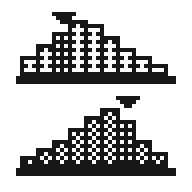
A player's solution is plotted against distributions of other players' scores on several metrics.
definition
After a solution passes validation, the game computes several independent metrics that trade off against each other and shows the player's value on each as a marker on a histogram of all players' (or friends') values for that puzzle. State owned: per-puzzle score distributions aggregated on a server, plus the player's best per metric. Update rule: on completion, simulate the solution, compute metrics, upload them, and fetch the current distributions. The metrics come from a design-evaluation mechanic; this mechanic owns only the population comparison. Canonical forms are Zachtronics games: SpaceChem ranks instructions, cycles, and reactors, and Zach Barth designed its global histograms so players could check a solution without being overwhelmed by the top players a leaderboard lists; Opus Magnum compares cost, cycles, and area; TIS-100, Shenzhen I/O, Infinifactory, and Exapunks use the same pattern.
player experience
Instead of a rank, the player sees where they sit in a crowd on each axis. A solution that is slow but cheap still feels good, and a visible tail of better scores invites returning to a solved puzzle to shave cycles. Comparison is social but low in intimidation.
design levers
- number of metrics and how strongly they trade off against each other
- global distribution versus friends-only comparison
- bin width and handling of outliers or exploit scores
- per-metric personal bests versus recognition of Pareto-optimal combinations
- whether any reward is attached to good scores (Zachtronics deliberately attaches none)
failure modes
- Metrics that do not trade off collapse into one dominant solution, and the histograms show a single spike.
- Exploit or bugged solutions create impossible scores that distort the left tail.
- Late puzzles are attempted only by skilled survivors, so average players appear below median on every metric.
- Independent per-metric bars ignore balanced solutions; Opus Magnum players invented an unofficial sum metric to score them.
dynamics
- Players replay solved puzzles to move their marker, extending content life without new content.
- Communities build external record trackers for Pareto frontiers that the in-game histograms do not show.
- Friend comparison produces asynchronous rivalry without direct competition.
open questions
- Can distributions seeded by automated solvers before launch give useful comparison targets without discouraging human players?
- Does showing a Pareto frontier instead of per-metric histograms change which tradeoffs players explore?
appears in
the paper, 2 sectionsrelations
4 stored edges Design performance rating
Multi-metric ratings become social when plotted against everyone else's solutions (Opus Magnum).
 Player programming
Open-ended programming puzzles gain replay value from optimization histograms.
 Storyteller director
Directed randomness makes scores incomparable across players.
backlinks
computed from other records LLM-guided evolutionary program search
claims
3 with sourcesZach Barth designed SpaceChem's global histograms so players could check their solutions without feeling overwhelmed by the top players a leaderboard would list.
Opus Magnum ranks solutions on cycles, cost, and area, and players combine them in an unofficial sum statistic.
Zachtronics deliberately offers no in-game rewards for optimization in Opus Magnum, so players who optimize do so for intrinsic reasons.