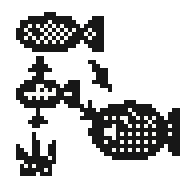
food-web mechanic sourced
Food web
Species eat and are eaten along a feeding graph, so populations rise, crash, and oscillate under predator-prey dynamics.
definition
Owns population counts per species (aggregate) or individual animals (agent-based) and a directed feeding graph of who eats whom. Each tick prey grow toward a carrying capacity set by plants or habitat, predators remove prey in proportion to encounters, and predators reproduce from food eaten and starve without it. The Lotka-Volterra form, published by Volterra in 1926, has prey growing at rate a and consumed at rate b times predators, and predators converting prey into growth while dying at a constant rate; the result cycles without damping. Games add carrying capacity, starvation, migration, and respawn so species do not drift to extinction. SimLife and Species: Artificial Life, Real Evolution let creatures eat each other on a shared map; Eco simulates plant and animal populations that players can overhunt; Viva Pinata attracts visitors and predators according to garden contents. Inputs are species, habitat, and harvesting; outputs are population trajectories.
player experience
Tending a system the player cannot command. Adding a predator to fix overgrazing can crash the herbivores and then starve the predator a few generations later. The player learns to act through balance and delay, watches population graphs, and feels responsible when a species disappears.
design levers
- feeding graph topology: number of species, diet breadth, and omnivores
- prey growth rate and carrying capacity from plants or habitat
- predation efficiency and conversion of food into offspring
- starvation and natural death rates, and the minimum population before extinction
- immigration or respawn rules that rescue extinct species
- aggregate populations versus individually simulated animals
failure modes
- Undamped predator-prey cycles drift until a population hits zero, so ecosystems collapse without any player error.
- Hidden population floors or respawns added to prevent extinction make overhunting consequence-free.
- Long delays between action and population response hide cause and effect, so players read crashes as random.
dynamics
- Trophic cascades: removing a top predator lets herbivores strip vegetation, which lowers carrying capacity for everything.
- Player hunting or harvesting acts as an extra predator and can tip a stable cycle into collapse.
- Coupled with habitat or climate change, species ranges shift and new feeding links form.
open questions
- Can learned behavior models give individually simulated animals plausible foraging and avoidance at ecosystem scale without hand-written AI?
- Which visualizations make delayed predator-prey feedback legible without population graphs?
appears in
the paper, 2 sections · 1 chapterrelations
2 stored edges Habitat suitability
Habitat defines which species can co-occur, which sets the possible food webs.
 Natural selection
Predation supplies selective pressure; selection reshapes the food web over generations.
 Simulation-based inference for calibrating simulators