atlas simulation games, part by part
The Grammar of Simulation
Every simulation game is assembled from a shared set of parts: production chains, needs, markets, weather, raids. Naming the parts shows why games feel alike, which combinations the catalog has not seen yet, and where AI can change how a game plays.
Here a simulation game is one whose core loop is driven by a model of some system, such as an economy, an ecology, a body, or a machine, whose state changes without the player scripting each change.
four findings from the paper; each links to the section that makes the case






















































































































Each icon is one mechanic, a rule-system a designer would recognize across games. Point at one to see what it is, or open it.
plain-text twin · 21 families
Treasury and budget, Contracts and orders, Staff hiring and rosters, Trade routes, Loans and debt, Taxation, Supply-demand pricing, Customer value choice, Rival firms, Advertising and awareness, Labor market, Land value, Player-driven markets, Auctions, Equity and buyouts, Negotiation, Product development, RCI demand, Delivery-time payment
Agent skills, Needs decay, Personality traits, Utility action selection, Memories and thoughts, Agent pathfinding, Daily schedules, Mood and breakdowns, Crowd preferences, Work priorities, Creature learning, Smart objects, Aspirations and wants, Attribute-driven match engine, Autonomy levels, Stress accumulation
start with a game you know
all 179 gamesEach game drawn as the parts it is built from, core parts first. Open one to see how it does each part, and which other games share them.
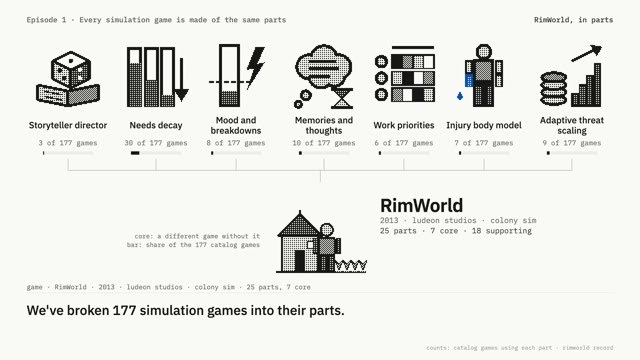
episode 1 5:27
Every simulation game is made of the same parts
RimWorld taken apart into its mechanics, then every game in the catalog the same way. Most of the commonest parts simulate nothing, the parts a game can't do without are much rarer, and each genre spends its parts differently.
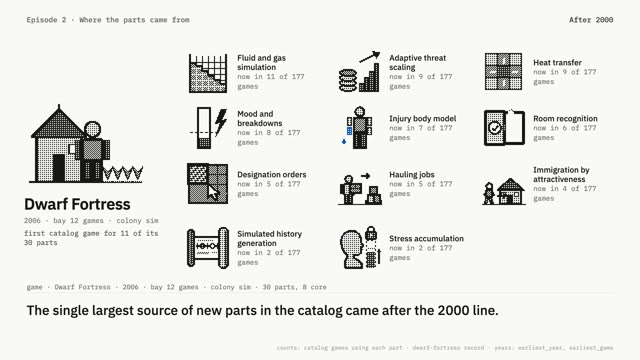
episode 2 7:47
Where the parts came from
Hamurabi, from 1968, already used parts that games still use. Most of the vocabulary was in a catalog game by 2000, a test against chance shows how much of that comes from parts being widely shared, and recent games are built mostly from old parts.
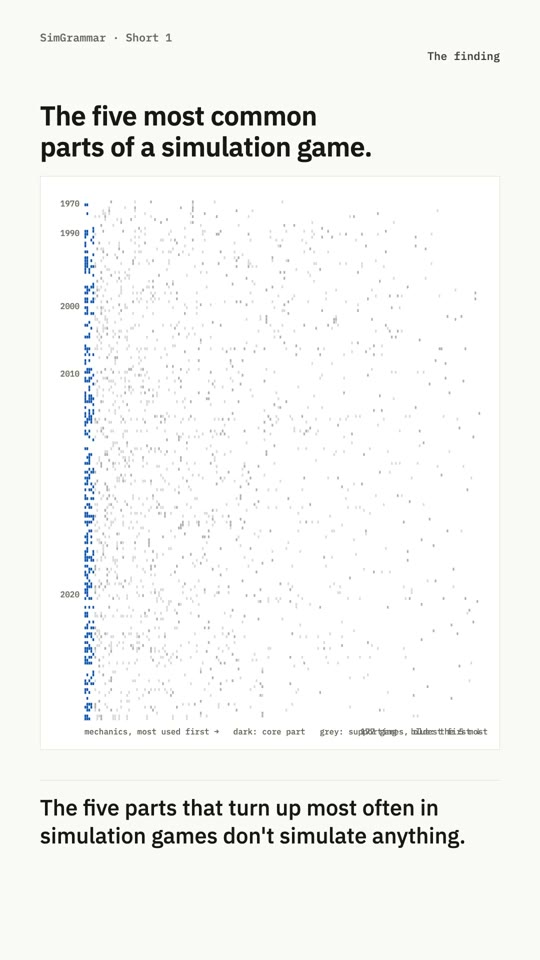
short 1 0:43 from chapter 1 · episode 1
The five most common parts
Most of the parts that turn up most often in simulation games don't simulate anything.
 Factorio
 RimWorld
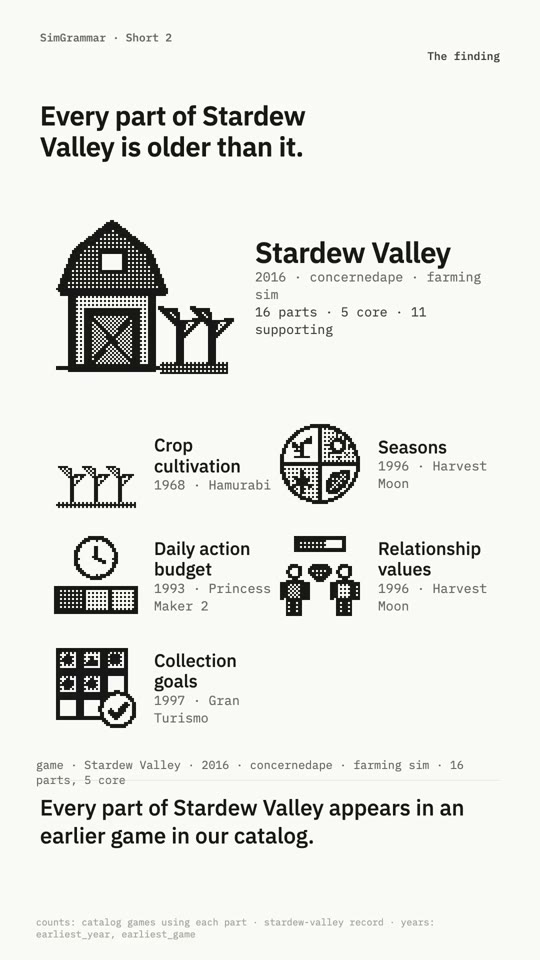
short 2 0:41 from chapter 3 · episode 2
Every part of Stardew Valley is older than it
Every part of Stardew Valley appears in an earlier game in our catalog.
 Stardew Valley
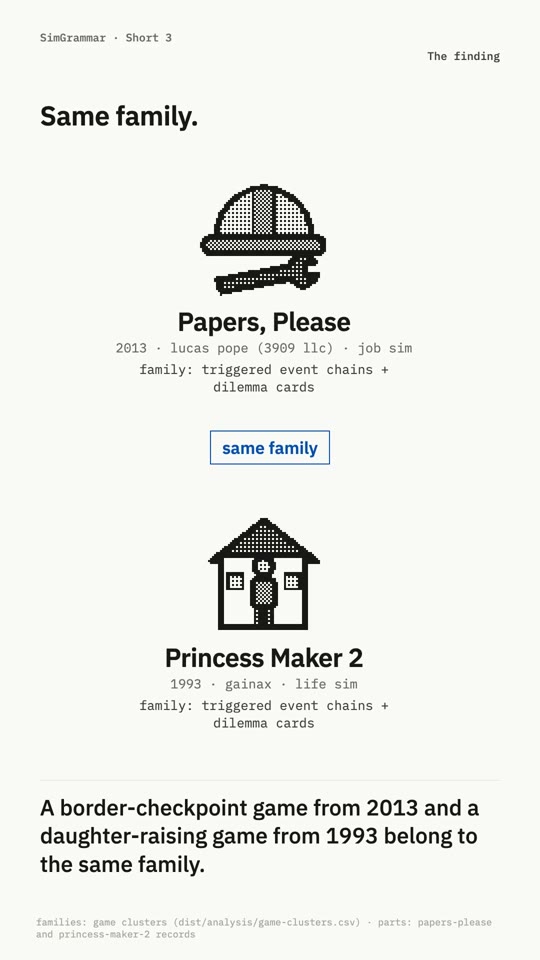
short 3 0:36 from chapter 4 · episode 3
A border post and a daughter
A border-checkpoint game from 2013 and a daughter-raising game from 1993 belong to the same family.
 Princess Maker 2
 Papers, Please
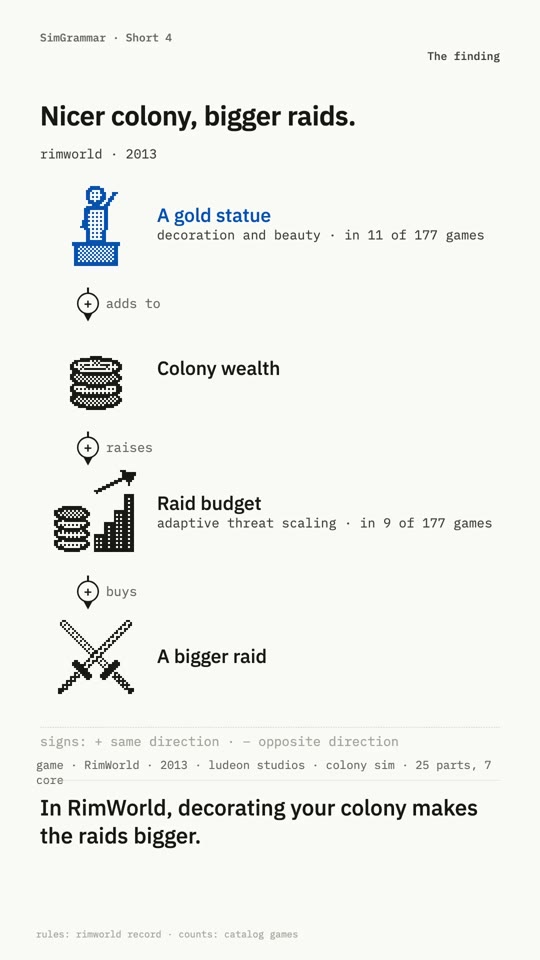
short 4 0:36 from chapter 5 · episode 4
Decorating makes the raids bigger
In RimWorld, decorating your colony makes the raids bigger.
ai that already reaches games
all 46 techniquesThe techniques furthest along in shipped games, and the mechanics each one changes.

Neural rendering in the graphics pipeline
Small neural networks inside the renderer upscale frames, generate extra frames, denoise ray tracing, decode compressed textures and layered materials, and since DLSS 5 re-light the final frame, all without touching simulation state.

Generative agents (memory stream, reflection, planning)
LLM-driven characters that store observations in a natural-language memory stream, retrieve them by recency, importance, and relevance, synthesize reflections, and plan their day top-down.
Agent-based automated playtesting and balancing
Studios train imitation, reinforcement learning, and search agents to play builds, estimating level difficulty, pass and churn rates, progression pacing, map coverage, and exploits before players reach them.

LLM game master and narrative director
A language model that adjudicates player and NPC intentions, decides outcomes, generates events and quests, and narrates them, either free-form or checked against a typed world state and canon.
LLM-adjudicated state transitions (LLM as game mechanic)
A language model computes the outcome of an interaction (two elements combined, an action on an object) from a text description of the inputs, with results cached so every player sees the same rule.
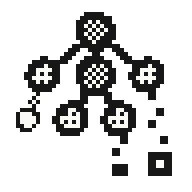
Monte Carlo tree search for game AI
A best-first search that grows a game tree from repeated simulated playouts and picks branches with a bandit rule such as UCT, letting AI players plan from a forward model without a hand-tuned evaluation function.
what could be built next
all 42 betsDesign bets ranked by impact, feasibility, and novelty. Each one names a test a small team could run and a dated prediction anyone can check.

Why-query over the simulation log
Let players ask why something happened and answer from the simulation's own event log, making deep systemic games legible without simplifying them.
Branch preview of policy futures
Fork the simulation in the background and show the player likely futures of a decision before committing, using parallel or surrogate simulation.
Event-sourced simulation runtime
An engine layer that records simulation and model calls as an append-only event log, giving replay, forking, explanation, and determinism for games with AI components.
Mechanic modding by description
Players describe a rule change in plain language; a model writes the mod against the modding API and automated agents test it before it is shared.
the book
contentsThe findings at book length, for reading straight through: what the parts are, how they trade off, where AI lands, and what to build.
The grammar
1. Same parts · 2. Six layers · 3. Old parts · 4. Families · 5. Rated deep, rated hard to read · 6. Five ceilings
The machines arrive
Bets and checks
How the book is made
the paper and the data
The Grammar of Simulation
Every finding with its method and statistics, figures you can explore, and the full catalog of games and techniques. The place to check a claim.
How the atlas is made
Every game, mechanic, and technique is an open record with its sources, so any number here can be traced to where it came from, checked, and corrected by anyone.